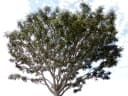
Schizolobium parahyba
Schizolobium parahyba
Safety & Hazards
None known
Cultivation Details
A plant of the tropics, where it is found at elevations from sea level up to 2,200 metres. It grows best in areas where annual daytime temperatures are within the range 20 - 26°c, but can tolerate 9 - 30°c[1]. It prefers a mean annual rainfall in the range 1,200 - 1,600mm, but tolerates 1,000 - 1,800mm[1]. Grows best in a sunny position[2]. Prefers a well drained, moist, loamy to clay soil[3, 1]. Prefers a fertile soil, but can succeed in soils of low fertility[1]. Prefers a Ph in the range 5.5 - 6.5, tolerating 4.5 - 7.5[1]. Established trees are drought tolerant[1]. Schizolobium parahyba is one of the fastest growing tree species, which is why it has been widely introduced in tropical regions; mainly for reforestation projects, as an ornamental or as a shade tree. It is a pioneer species, with large seeds that help its quick establishment, even in thick ground cover and litter. Although not being considered as an invasive species in most of its range, it has sometimes been noted to have invaded managed pastures and airport grass strips. It is considered as invasive in the seasonal semideciduous forests in Sao Paulo, Brazil, although the invaded area is not large, and its spread has not been extensive[4]. A very fast growing tree, it can be 8 - 10 metres tall after 2 years[2]. It can be grown with a 6 - 8 year pulpwood rotation[1]. Annual wood production can be up to 20 tonnes per hectare[1]. The tree has enormous double-compound leaves that sometimes exceed 2 metres. These leaves can sometimes make people confuse a young plant with a fern or palm[5]. The tree has brittle branches that break off easily in the wind[2]. This species has a symbiotic relationship with certain soil bacteria, these bacteria form nodules on the roots and fix atmospheric nitrogen. Some of this nitrogen is utilized by the growing plant but some can also be used by other plants growing nearby[6].
Propagation
Seed - it has a hard seedcoat and may benefit from scarification before sowing to speed up germination. This can usually be done by pouring a small amount of nearly boiling water on the seeds (being careful not to cook them!) and then soaking them for 12 - 24 hours in warm water. By this time they should have imbibed moisture and swollen - if they have not, then carefully make a nick in the seedcoat (being careful not to damage the embryo) and soak for a further 12 hours before sowing. Sow the seed in a partially shaded position in individual containers. A germination rate of around 85% can be expected, with the seed sprouting within 5 - 15 days[2]. Cite as: Tropical Plants Database, Ken Fern. tropical.theferns.info. 2026-02-20. <tropical.theferns.info/viewtropical.php?id=Schizolobium+parahyba>
Pollinators
Bees
References
- [1]Ecocrop — http://ecocrop.fao.org/ecocrop/srv/en/home ↩︎Basic information on a wide range of useful plants, plus details of environmental needs where available.
- [2]Brazilian Trees. Volume 1. 4th Edition. — Lorenzi. H. · Instituto Plantarum De Estudos Da Flora; Brazil. · 2002 · ISBN 85-86714-17-8 ↩︎Information on 350 species of Brazilian trees. Stunning photographs of each species, brief details on the plant, its uses and how to grow it from seed. A superb work, with the minor irritation that the translation from Portuguese is not of the best.
- [3]World Agroforesty Centre — http://www.worldagroforestry.org/ ↩︎An excellent online database of a huge range of trees giving very good information on each plant - its uses, ecology, identity, propagation, pests etc.
- [4]Invasive Species Compendium — http://www.cabi.org ↩︎An immense resource - in depth information on over 900 species of invasive plants (it also has information on animals, fungi etc).
- [5]Flowers of India — http://www.flowersofindia.net/ ↩︎A wed site of native Indian plants, plus cultivated and naturalized species. It has good quality photos and terse details on more than 3,000 species and cultivars.
- [6]The New RHS Dictionary of Gardening. 1992. — Huxley. A. · MacMillan Press · 1992 · ISBN 0-333-47494-5 ↩︎Excellent and very comprehensive, though it contains a number of silly mistakes. Readable yet also very detailed.
- [7]IUCN Red List of Threatened Species — http://www.iucnredlist.org/ ↩︎A list of plants under threat and facing possible extinction, usually with brief details of the threats and information on habitat.
- [8]Botanical Beads — Smith R.J. · http://www.botanicalbeads.com/ ↩︎A website looking at seeds that are used for ornament. It is based on a book that the author had written.
- [9]Technical Information on 134 Species of Bolivian Woods — USDA Forest Service -- Forest Products Lab · USDA Forest Service · http://www2.fpl.fs.fed.us/publications/ ↩︎A PDF file, available for download. Exactly what the title says, brief and to the point.
- [10]South American Timbers: the Properties, Uses and Characteristics of 190 Species. — Bolza. E. & Christensen. F.J. · Commonwealth Scientific and Industrial Research Organization · 1979 · ISBN 0 643 02582 0 ↩︎A very useful guide.