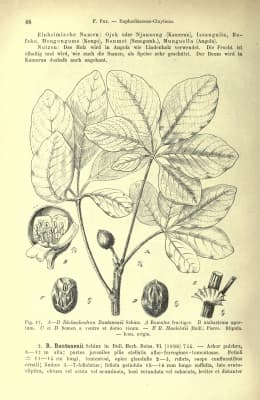
Schinziophyton rautanenii
Schinziophyton rautanenii
Safety & Hazards
None known
Cultivation Details
Mongongo nut is a plant of arid to moist tropical and subtropical areas where it is found at elevations ranging from 50 - 1,500 metres, more commonly at the higher end of the range[1, 2]. It grows best in areas where annual daytime temperatures are within the range 18 - 30°c, but can tolerate 10 - 40°c[2]. When dormant, the plant can survive temperatures down to about -7°c, but young growth can be severely damaged at -1°c[2]. It prefers a mean annual rainfall in the range 500 - 800mm, but tolerates 400 - 1,000mm[2]. It can tolerate mean rainfall as low as 150mm[1]. Grows best in a sunny position[2]. Requires a well-drained soil, and is not found on compacted clay soils or areas subject to flooding[1]. Prefers a pH in the range 6.5 - 8, tolerating 6 - 8.5[2]. Established plants are drought tolerant[1]. Strong winds often cause immature fruits to drop[3]. The growth from seedling to sapling stage depends very much on the fire regime prevailing in the area. Fires reduce young saplings back to ground level as long as their bark is too thin to protect them[3]. Plants coppice well when young[3]. Trees may start flowering and fruiting when about 20 years old, and can live up to 100 years[3]. Fruit production is very closely linked to the amount of rain of the previous season, with crop yields higher in years following heavy rains[3]. High rainfall after flowering has been found to damage the developing fruits, as do fires late in the dry season[3]. Limited data are available on yields, although some estimates indicate yields of 200 - 1000 kilos per hectare in northern Namibia, and about 300 kilos in Angola[3]. A dioecious plant, both male and female forms must be grown if fruit and seed are required[4].
Propagation
Seed. The woody endocarp makes germination difficult and therefore needs to be removed or the end cut off to expose the kernel prior to sowing[1]. After shelling, the seeds can be soaked in water for a week followed by storage under high temperature and humidity for two days in order to reach better germination[1]. Germination is erratic and takes place over an extended period. Without pre-treatment a germination rate of 26% has been obtained[1]. If the shell is removed prior to sowing and the kernel is treated with ethylene the germination rate can reach 80% or more within 6 days[1]. The rate of non-surviving seedlings is high but once a seedling has been established it needs little attention[1]. The seeds should be sown in sandy soil in half shade and the temperature kept above 7°c[1]. The seedlings very quickly develop deep roots. When the seed has germinated, the radicle grows slowly. When it is 5 - 10cm long, 5 - 12 secondary roots emerge in a ring from immediately above the root-tip, resembling a Medusa’s head. When these roots are 20 - 50mm long the plumule starts to emerge[3]. The seed remains viable for 2 years if stored at 10°c[1]. Truncheons root readily and are used for propagation[3]. Cite as: Tropical Plants Database, Ken Fern. tropical.theferns.info. 2026-02-20. <tropical.theferns.info/viewtropical.php?id=Schinziophyton+rautanenii>
Pollinators
Data unavailable
References
- [1]Seed Leaflets — Various · Forest & Landscape. Denmark · http://en.sl.life.ku.dk/Publikationer/Udgivelser/PopulaerPublikationer.aspx?katid={D28373CC-6EF3-4EF8-B097-6D83FABF209E}&serieid={9F1C3DB1-6E7B-4CF1-AF53-F480B0CB40EF}&sort=title ↩︎A series of leaflets, jointly produced by the University of Copenhagen and the Royal Botanic Gardens at Kew, focussing on seed information for a number species, but also giving a lot of other information about each plant.
- [2]Ecocrop — http://ecocrop.fao.org/ecocrop/srv/en/home ↩︎Basic information on a wide range of useful plants, plus details of environmental needs where available.
- [3]Protabase - Plant Resources of Tropical Africa. — http://www.prota.org ↩︎An excellent on-line database with detailed information on over 3,200 species of useful plants of Africa.
- [4]Flora Zambesiaca — http://apps.kew.org/efloras/fz/intro.html ↩︎An excellent online flora of plants from the Zambezi River basin. It lists a number of the plant uses as well as the habitats and botanical descriptions of the plants.
- [5]Nuts. — Howes. F. N. · Faber · 1948 · ISBN - ↩︎Rather old but still a masterpiece. Has sections on tropical and temperate plants with edible nuts plus a section on nut plants in Britain. Very readable.
- [6]Cornucopia II — Facciola. S. · Kampong Publications, California. · 1998 · ISBN 0-9628087-2-5 ↩︎The second edition of an excellent guide to the edible uses of plants, though it does not give any details of cultivation etc.
- [7]Edible Wild Plants of Tanzania — Ruffo, C.K.: Birnie, A. & Tengnas, B. · Regional Land Management Unit; Nairobi. · 2002 · ISBN 9966-896-60-0 ↩︎A very well presented, simple guide to growing and utilizing wild food plants in Tanzania, with line drawings of each plant, a description, habitat and range, non-food as well as food uses, plus basic information on growing the plants.
- [8]Dictionary of Economic Plants. — Uphof. J. C. Th. · Weinheim · 1959 · ISBN - ↩︎An excellent and very comprehensive guide but it only gives very short descriptions of the uses without any details of how to utilize the plants. Not for the casual reader.