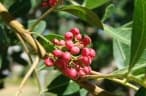
Schinus terebinthifolia
Schinus terebinthifolia
Safety & Hazards
The seeds are known to cause rashes, vomiting and diarrhoea in some sensitive individuals[1]. The plant is notorious for causing respiratory problems and dermatitis in people who are allergic to it[2]. This is mainly caused by the copious pollen produced by male plants which produces a gaseous material[2].
Cultivation Details
Brazilian peppertree is a plant of subtropical to tropical climates, where it can be found at elevations up to 2,000 metres. It grows in areas where the mean annual temperature can range from 12 - 26°c, with a mean maximum temperature in the hottest month of 20 - 28°c, a mean minimum temperature in the coldest month of 8 - 24°c, and an absolute minimum temperature of -6°c. The mean annual rainfall is within the range 950 - 2,200mm[3]. Prefers a sunny position in most well-drained soils, though also tolerating seasonal inundation of the soil[4]. Succeeds in poor, dry soils and in acid conditions in the wild[5]. This is a highly invasive species that has proved to be a serious weed in South Africa, Florida and Hawaii. It is also noted as invasive in other Caribbean and Indian Ocean islands. Rapid growth rate, wide environmental tolerance, prolific seed production, a high germination rate, seedling tolerance of shade, attraction of biotic dispersal agents, possible allelopathy and the ability to form dense thickets all contribute to this species' success in its exotic range[3, 2]. A fast-growing species, easily reaching a height of 4.5 metres within 2 years[6]. The tree can start producing seed when only 3 years old[3]. The holly-like fruit is very popular for Christmas decoration in some areas[2]. A dioecious species, both male and female forms need to be grown if fruit and seed are required[2].
Propagation
Seed - best sown as soon as it is ripe in a sunny position in a nursery seedbed. A germination rate of above 50% can be expected, with the seed sprouting within 10 - 15 days[6]. Cite as: Tropical Plants Database, Ken Fern. tropical.theferns.info. 2026-02-20. <tropical.theferns.info/viewtropical.php?id=Schinus+terebinthifolia>
Pollinators
Bees, Insects
References
- [1]Cornucopia II — Facciola. S. · Kampong Publications, California. · 1998 · ISBN 0-9628087-2-5 ↩︎The second edition of an excellent guide to the edible uses of plants, though it does not give any details of cultivation etc.
- [2]Tropical and Subtropical Trees - A Worldwide Encyclopaedic Guide. — Barwick. M. · Thames & Hudson, London · 2004 · ISBN 0-500-51181-0 ↩︎A superb book, very concise and well written, giving a wealth of information on 400 or more species including descriptions, habitat, cultivation details and plant uses. A wealth of colour photographs bring each plant vividly to life.
- [3]World Agroforesty Centre — http://www.worldagroforestry.org/ ↩︎An excellent online database of a huge range of trees giving very good information on each plant - its uses, ecology, identity, propagation, pests etc.
- [4]The New RHS Dictionary of Gardening. 1992. — Huxley. A. · MacMillan Press · 1992 · ISBN 0-333-47494-5 ↩︎Excellent and very comprehensive, though it contains a number of silly mistakes. Readable yet also very detailed.
- [5]Medicinal Plants of Brazil — Mors W.B.; Rizzini C.T.; Pereira N.A. · Reference Publications; Michigan. · 2000 · ISBN 0-917256-42-5 ↩︎An extremely concise book, listing approximately 1,500 species and varieties of plants with their botanical name, common name in Brazil, regions in Brazil where the plant is found, a brief list of uses and any medically active compounds in the plant.
- [6]Brazilian Trees. Volume 1. 4th Edition. — Lorenzi. H. · Instituto Plantarum De Estudos Da Flora; Brazil. · 2002 · ISBN 85-86714-17-8 ↩︎Information on 350 species of Brazilian trees. Stunning photographs of each species, brief details on the plant, its uses and how to grow it from seed. A superb work, with the minor irritation that the translation from Portuguese is not of the best.
- [7]Dictionary of Economic Plants. — Uphof. J. C. Th. · Weinheim · 1959 · ISBN - ↩︎An excellent and very comprehensive guide but it only gives very short descriptions of the uses without any details of how to utilize the plants. Not for the casual reader.
- [PFAF]Plants for a Future — pfaf.org ↩︎