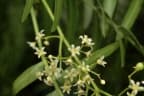
Schinus molle
Schinus molle
Safety & Hazards
The seed contains an allergenic substance that can irritate the mucus membrane[1]. In large quantities, they can be toxic[2]. The leaves can cause contact dermatitis[2]. The gum-resin found in the bark can give rise to contact dermatitis[3]. The pollen, either on contact or when inhaled, can cause dermatitis and asthmatic reactions[4].
Cultivation Details
Schinus molle is a plant of the subtropics to higher elevations in the tropics, where it can be found at elevations up to 3,900 metres, especially near the Equator. It is found especially in drier areas with a mean annual rainfall in the range 300 - 700mm[5]. The mean annual temperature is in the range 15 - 20°c, established plants can tolerate some fros and can succeed outdoors in the milder regions of the temperate zone[6, 1, 7]. Prefers a well-drained soil in full sun, but also tolerates the light shade of other trees[1, 7]. It likes growing in sandy soils[8] and succeeds in a hot dry position[6]. It grows well on stony sites and slopes[5, 7]. It is tolerant of some salinity in the soil and also alkalinity[5]. Prefers a pH in the range 6.5 - 7.5, tolerating 6 - 8.5[9]. Established plants are extremely drought resistant[5]. Tolerant of salt-laden winds[9]. Seedling trees are easily established and are fast growing - after one year they will normally have attained a height of 3 metres and they reach maturity in less than 20 years[5]. The tree has a low-branching habit and pruning of lower branches is recommended when the tree is young[5]. Trees respond well to coppicing and pollarding[4, 5]. The oily leaves smell and taste of pepper when they are crushed[10]. Dioecious, both male and female forms must be grown if seed is required.
Propagation
Seed - the oil in the pericarp may inhibit germination, so it is important to wash the seeds thoroughly in running water for 24 hours before sowing - this will also prevent the seed from attracting ants in the seedbed and protect from fungal infections. The seeds can be sown in a nursery seedbed or directly in individual containers, placing two seeds in each container. It is recommended to use a light and permeable substrate, maybe because inhibitors need to be washed out before the seeds can germinate[5]. Germination starts after about two weeks and is normally terminated after four weeks. Germination is reported to be 60 - 80% but in some places, especially where the species is grown outside the area of natural distribution, low germination in the nursery is a problem[5]. Prick out the seedlings into individual pots once they are large enough to handle and, when they are 30 - 35 cm tall, they are ready for planting in the field[5]. Seeds can be stored for at least 12 months[7]. Cuttings of almost ripe wood, 8cm with a heel, August to early September in a frame. Fair to good percentage[11]. Cite as: Temperate Plants Database, Ken Fern. temperate.theferns.info. 2026-02-21. <temperate.theferns.info/plant/Schinus+molle>
Pollinators
Bees
References
- [1]The New RHS Dictionary of Gardening. 1992. — Huxley. A. · MacMillan Press · 1992 · ISBN 0-333-47494-5 ↩︎Excellent and very comprehensive, though it contains a number of silly mistakes. Readable yet also very detailed.
- [2]Desert Tropicals — http://www.desert-tropicals.com/ ↩︎The main focus of the site is succulent plants, but it also contains information on a wide range of other species. Usually at least one good photograph, plus basic information about the plant and its cultivation.
- [3]Medicinal Plants of Brazil — Mors W.B.; Rizzini C.T.; Pereira N.A. · Reference Publications; Michigan. · 2000 · ISBN 0-917256-42-5 ↩︎An extremely concise book, listing approximately 1,500 species and varieties of plants with their botanical name, common name in Brazil, regions in Brazil where the plant is found, a brief list of uses and any medically active compounds in the plant.
- [4]World Agroforesty Centre — http://www.worldagroforestry.org/ ↩︎An excellent online database of a huge range of trees giving very good information on each plant - its uses, ecology, identity, propagation, pests etc.
- [5]Seed Leaflets — Various · Forest & Landscape. Denmark · http://en.sl.life.ku.dk/Publikationer/Udgivelser/PopulaerPublikationer.aspx?katid={D28373CC-6EF3-4EF8-B097-6D83FABF209E}&serieid={9F1C3DB1-6E7B-4CF1-AF53-F480B0CB40EF}&sort=title ↩︎A series of leaflets, jointly produced by the University of Copenhagen and the Royal Botanic Gardens at Kew, focussing on seed information for a number species, but also giving a lot of other information about each plant.
- [6]The Milder Garden. — Taylor. J. · Dent · 1990 ↩︎A good book on plants that you didn't know could be grown outdoors in Britain.
- [7]Brazilian Trees. Volume 1. 4th Edition. — Lorenzi. H. · Instituto Plantarum De Estudos Da Flora; Brazil. · 2002 · ISBN 85-86714-17-8 ↩︎Information on 350 species of Brazilian trees. Stunning photographs of each species, brief details on the plant, its uses and how to grow it from seed. A superb work, with the minor irritation that the translation from Portuguese is not of the best.
- [8]The RHS Gardener's Encyclopedia of Plants and Flowers — Brickell. C. · Dorling Kindersley Publishers Ltd. · 1990 · ISBN 0-86318-386-7 ↩︎Excellent range of photographs, some cultivation details but very little information on plant uses.
- [9]Ecocrop — http://ecocrop.fao.org/ecocrop/srv/en/home ↩︎Basic information on a wide range of useful plants, plus details of environmental needs where available.
- [10]Scented Flora of the World. — Genders. R. · Robert Hale. London. · 1994 · ISBN 0-7090-5440-8 ↩︎An excellent, comprehensive book on scented plants giving a few other plant uses and brief cultivation details. There are no illustrations.
- [11]Propagation of Trees, Shrubs and Conifers. — Sheat. W. G. · MacMillan and Co · 1948 · ISBN - ↩︎A bit dated but a good book on propagation techniques with specific details for a wide range of plants.
- [12]IUCN Red List of Threatened Species — http://www.iucnredlist.org/ ↩︎A list of plants under threat and facing possible extinction, usually with brief details of the threats and information on habitat.
- [13]Dictionary of Economic Plants. — Uphof. J. C. Th. · Weinheim · 1959 · ISBN - ↩︎An excellent and very comprehensive guide but it only gives very short descriptions of the uses without any details of how to utilize the plants. Not for the casual reader.
- [14]Plants for Human Consumption. — Kunkel. G. · Koeltz Scientific Books · 1984 · ISBN 3874292169 ↩︎An excellent book for the dedicated. A comprehensive listing of Latin names with a brief list of edible parts.
- [15]Meet Flora Mexicana. — Pesman. M. W. · Dale S. King. Arizona. · 1962 · ISBN - ↩︎Very readable flora but rather lacking botanically. A few notes on useful plants.
- [16]Cornucopia - A Source Book of Edible Plants. — Facciola. S. · Kampong Publications · 1990 · ISBN 0-9628087-0-9 ↩︎Excellent. Contains a very wide range of conventional and unconventional food plants (including tropical) and where they can be obtained (mainly N. American nurseries but also research institutes and a lot of other nurseries from around the world.
- [17]Sturtevant's Edible Plants of the World. — Hedrick. U. P. · Dover Publications · 1972 · ISBN 0-486-20459-6 ↩︎Lots of entries, quite a lot of information in most entries and references.
- [18]The Complete Trees of N. America. Field Guide and Natural History. — Elias. T. · Van Nostrand Reinhold Co. · 1980 · ISBN 0442238622 ↩︎A very good concise guide. Gives habitats, good descriptions, maps showing distribution and a few of the uses. It also includes the many shrubs that occasionally reach tree proportions.