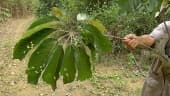
Schefflera morototoni
Schefflera morototoni
Safety & Hazards
None known
Cultivation Details
A plant of the moist tropics, often where there is a distinct dry season. Requires a sunny position[1]. Also succeeds in dappled shade[2]. Succeeds in a range of soils, but most frequently found in the wild in clayey, acid soils[1]. Prefers a pH in the range 5 - 7, tolerating 4.5 - 7.5[3]. A fast growing tree, easily reaching a height of 3 - 4 metres within 2 years from seed[2]. Plants can flower and fruit virtually throughout the year[1]. The seeds can withstand forest fires, sprouting freely shortly afterwards[3]. Trees can be coppiced successfully[1].
Propagation
Seed - it has a viability of less than 60 days and so is best sown as soon as it is ripe in a semi-shaded position in a nursery seedbed. Germination rates are usually very low, with the seed sprouting within 60 - 100 days[2]. It is possible that scarification of the seeds could improve germination rates and shorten the time taken to germinate[2]. The seedlings grow away quickly and are easy to transplant[1]. In the wild, the seeds germinate soon after there has been a fire[1]. Seed storage behaviour is orthodox; no loss in viability following 11 months of storage at 12°c[1]. Cite as: Tropical Plants Database, Ken Fern. tropical.theferns.info. 2026-02-20. <tropical.theferns.info/viewtropical.php?id=Schefflera+morototoni>
Pollinators
Data unavailable
References
- [1]World Agroforesty Centre — http://www.worldagroforestry.org/ ↩︎An excellent online database of a huge range of trees giving very good information on each plant - its uses, ecology, identity, propagation, pests etc.
- [2]Brazilian Trees. Volume 1. 4th Edition. — Lorenzi. H. · Instituto Plantarum De Estudos Da Flora; Brazil. · 2002 · ISBN 85-86714-17-8 ↩︎Information on 350 species of Brazilian trees. Stunning photographs of each species, brief details on the plant, its uses and how to grow it from seed. A superb work, with the minor irritation that the translation from Portuguese is not of the best.
- [3]Ecocrop — http://ecocrop.fao.org/ecocrop/srv/en/home ↩︎Basic information on a wide range of useful plants, plus details of environmental needs where available.
- [4]A Century of Trees of Panama. — Pittier H. Mell C.D. · http://www.biodiversitylibrary.org ↩︎A work that was very difficult to get published according to the correspondence contained at the start!. A treatment of 100 different species with descriptions and details of uses. It can be downloaded from the Internet.
- [5]Medicinal Plants of the Guianas — DeFilipps, R. A.; Maina, S. L.; & Crepin, J. · Smithsonian Museum · http://botany.si.edu/bdg/medicinal/index.html ↩︎A down-loadable PDF document of a book in pre-publication awaiting illustration. An excellent, if rather terse, guide to the traditional medicinal uses of the plants of the region
- [6]Dictionary of Economic Plants. — Uphof. J. C. Th. · Weinheim · 1959 · ISBN - ↩︎An excellent and very comprehensive guide but it only gives very short descriptions of the uses without any details of how to utilize the plants. Not for the casual reader.