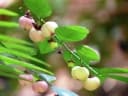
Sauropus androgynus
Sauropus androgynus
Safety & Hazards
None known
Cultivation Details
A plant of the tropics, where it is well adapted to lowland conditions but can also be cultivated at elevations up to 4,000 metres. It grows best in areas where annual daytime temperatures are within the range 26 - 35°c, but can tolerate 5 - 38°c[1]. It prefers a mean annual rainfall in the range 900 - 1,200mm, but tolerates 600 - 4,000 mm[1]. Succeeds in full sun and semi shade[2]. Survives dry conditions and does not require a rich soil[2]. Tolerant of very heavy soils[3]. Tolerant of heavy rainfall areas, though they prefer a well-drained soil[3]. Prefers a pH in the range 6 - 7, tolerating 5.5 - 7.5[1]. First harvest may be taken after 55 - 70 days[1]. Plants can be harvested throughout the year[1]. In Java, the plant flowers all year-round and fruiting is usually abundant[1]. Plants are fairly resistant to insect predations[2].
Propagation
Seed - borne in abundance on the plants, they germinate readily[3]. Cuttings - they strike readily[2]. Somewhat woody shoots, 20 - 30cm long are used[3]. Cite as: Tropical Plants Database, Ken Fern. tropical.theferns.info. 2026-02-20. <tropical.theferns.info/viewtropical.php?id=Sauropus+androgynus>
Pollinators
Data unavailable
References
- [1]Ecocrop — http://ecocrop.fao.org/ecocrop/srv/en/home ↩︎Basic information on a wide range of useful plants, plus details of environmental needs where available.
- [2]Tropical Food Gardens — Norrington. L. · Bloomings Books (Melbourne) · 2001 · ISBN 1-876473-41-x ↩︎Excellent little book giving some basic information on a range of plants.
- [3]Edible Leaves of the Tropics — Martin. F. W.; Ruberte. R. M. & Meitzner. L. S. · Echo. USA. · 1998 · ISBN 0-9653360-1-8 ↩︎A terse guide, giving reasonable detail on the more common leaf crops and brief information on a wide range of lesser known plants.
- [4]Flora of China — Missouri Botanical Garden Press; St. Louis. · 1994 · http://flora.huh.harvard.edu/china/ ↩︎An excellent, comprehensive resource in 25 volumes. In addition to the botanical information the flora also gives basic information on habitat and some uses. An on-line version is also available.
- [5]Mansfeld's Database of Agricultural and Horticultural Plants — http://mansfeld.ipk-gatersleben.de/pls/htmldb_pgrc/f?p=185:3:4292127278597336 ↩︎Terse details of a huge range of useful plants.
- [6]Vitamin C content of commonly eaten green leafy vegetables in fresh and under different storage conditions — Umaramani M. & Sivakanesan R. · 2015 · ISBN 2349 - 1183 ↩︎
- [7]Dictionary of Economic Plants. — Uphof. J. C. Th. · Weinheim · 1959 · ISBN - ↩︎An excellent and very comprehensive guide but it only gives very short descriptions of the uses without any details of how to utilize the plants. Not for the casual reader.
- [8]Cornucopia II — Facciola. S. · Kampong Publications, California. · 1998 · ISBN 0-9628087-2-5 ↩︎The second edition of an excellent guide to the edible uses of plants, though it does not give any details of cultivation etc.
- [9]Medicinal Plants in Vietnam — Nguyen Van Dan & Doan Thi Nhu · World Health Organisation · 1989 · ISBN 92 9061 101 4 ↩︎An excellent book, giving information on over 200 plants, their medicinal compounds and applications.