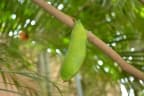
Saraca asoca
Saraca asoca
Safety & Hazards
None known
Cultivation Details
Saraca asoca is a plant of the moist tropical lowlands and requires an annual rainfall ranging from 2,000 - 4000 mm with a maximum temperature of 35 - 40°c[1]. Succeeds in a moderately sunny position, but grows well in moderate shade[1]. Prefers a moist, well-drained soil[1].A deep, moist soil, especially near a body of water, favours good growth[1]. Plants do not respond well to coppicing[1]. Trees are usually cut for their bark when around 20 years old. This should be carried out in the rainy season in order to promote resprouting[1]. Plants can flower and produce fruit throughout the year[2]. The flowers are fragrant[1]. Although many species within the family Fabaceae have a symbiotic relationship with soil bacteria, this species is said to be devoid of such a relationship and therefore does not fix atmospheric nitrogen[3].
Propagation
Seed - if the seed is harvested when ripe and sown immediately, preferably after soaking in water for 12 hours, it will germinate within 3 weeks and will be ready to plant out within 6 - 12 months[1]. Air layering[4]. Cite as: Tropical Plants Database, Ken Fern. tropical.theferns.info. 2026-02-20. <tropical.theferns.info/viewtropical.php?id=Saraca+asoca>
Pollinators
Insects
References
- [1]Ethnobotanical, phytochemical and pharmacological properties of Saraca asoca bark: A Review — Kauser A.S.; Hasan A.; Parrey S.A. & Ahmad W. · 2016 · http://www.ejpmr.com · ISBN 2394-3211 ↩︎
- [2]Flora Malesiana Series 1 — Various · Nationaal Herbarium Nederiand, Universiteit Leiden branch · http://www.archive.org ↩︎A massive treatment of the plants of the Malaysian Archipelago. Much of it has been made available to download from the Internet
- [3]The Leguminosae; A Source Book of Characteristics, Uses and Nodulation — Allen O.N.; Allen E.K. · University of Wisconsin · 1981 · ISBN 0-333-32221-5 ↩︎An amazing and comprehensive work, giving a brief guide to the many genera of the family Fabaceae and also the principle uses of the genus.
- [4]Encyclopedia of Tropical Plants - Identification and Cultivation of over 3,000 Tropical Plants — Ahmed Fayaz · Firefly Books Ltd.; New Zealand · 2011 · ISBN 978-1-55407-489 ↩︎A good photograph and terse but detailed information for over 3,000 species of tropical plants. An excellent reference.
- [5]Trade in Indian Medicinal Plants — D.K.Ved, S.Noorunnisa Begum, & K.Ravi Kumar · Apple Academic Press; Oakville, Canada · 2018 · ISBN 978-1-77188-600-0 ↩︎
- [6]A Manual of Indian Timbers. — Gamble. J. S. · Bishen Singh Mahendra Pal Singh · 1972 · ISBN - ↩︎First written in the 19th century, but still a classic, giving a lot of information on the uses and habitats of Indian trees. Not for the casual reader.
- [7]IUCN Red List of Threatened Species — http://www.iucnredlist.org/ ↩︎A list of plants under threat and facing possible extinction, usually with brief details of the threats and information on habitat.
- [8]Handbook of Ayurvedic Medicinal Plants — Kapoor. L. D. · CRC Press, Florida. · 2001 · ISBN 0-8493-2929-9 ↩︎A very detailed book on some of the key Ayurvedic herbs, giving both technical and non-technical information on each plant. The whole is very well referenced.
- [9]Dominica Botanic Gardens — http://www.da-academy.org/trees_shrubs.html ↩︎An on-line resource, providing top quality pictures and some basic information on various plants being grown at the Botanic Gardens, often including uses and habitat.
- [10]A Revision of the Genus Saraca L. (Legum. - Caes/) — Zuijderhoudt G.F.P. ↩︎
- [11]Glossary of Indian Medicinal Plants (Including the Supplement). — Chopra. R. N., Nayar. S. L. and Chopra. I. C. · Council of Scientific and Industrial Research, New Delhi. · 1986 · ISBN - ↩︎Very terse details of medicinal uses of plants with a wide range of references and details of research into the plants chemistry. Not for the casual reader.