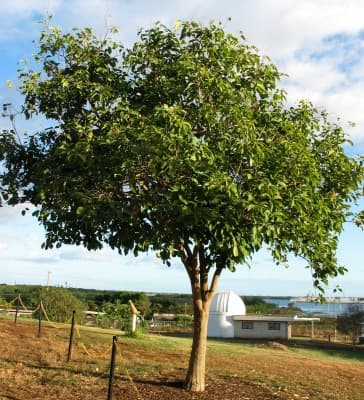
Sapindus oahuensis
Sapindus oahuensis
Safety & Hazards
None known
Cultivation Details
Prefers a position in full sun[1]. Very tolerant of a wide range of well-drained soils, including those that are dry, stony and nutrient deficient[1].
Propagation
Seed - best sown as soon as it is ripe[2]. There are conflicting reports on the usefulness of scarifying the seed, with some saying it makes no difference to germination rates and times, and others that it speeds up germination. If you scarify, then be careful not to harm the embryo. Soaking the seed for 24 hours in warm water after scarification might also be helpful[2]. Germination of untreated seeds or of seeds which have been scarified takes 1 - 6 months and the germination rate is variable since the seeds tend to rot[2]. The best germination results have been achieved when the seed was scarified with a clippers or a knife and then it was either kept in clean, moist vermiculite for 1 - 2 weeks, or was soaked in a shallow pan of water until the dark outer seed coat became soft (changing the water daily until this happened)[2]. Once the outer coat is soft, it can be removed by hand or with a small knife and then the thin papery brown inner coat should be carefully peeled off. This procedure leaves the cream coloured embryo exposed. Handle the embryo carefully so that the embryonic root is not damaged. The embryo should be planted immediately in sterile potting soil, burying it 10 - 20mm deep. With this method, germination takes place in about a week and the germination rate is almost 100%[2]. Cite as: Tropical Plants Database, Ken Fern. tropical.theferns.info. 2026-02-20. <tropical.theferns.info/viewtropical.php?id=Sapindus+oahuensis>
Pollinators
Data unavailable
References
- [1]The New RHS Dictionary of Gardening. 1992. — Huxley. A. · MacMillan Press · 1992 · ISBN 0-333-47494-5 ↩︎Excellent and very comprehensive, though it contains a number of silly mistakes. Readable yet also very detailed.
- [2]Hawaiian Native Plant Propagation Database — http://pdcs.ctahr.hawaii.edu:591/hawnprop/ ↩︎Detailed information on the propagation of a wide range of Hawaiian plants.
- [3]The Indiginous Trees of the Hawaiian Islands — Rock J.F. · 1913 · http://www.biodiversitylibrary.org ↩︎A guide to the trees and forests of Hawaii. Rather dated, but a good work. It can be downloaded from the Internet.
- [4]IUCN Red List of Threatened Species — http://www.iucnredlist.org/ ↩︎A list of plants under threat and facing possible extinction, usually with brief details of the threats and information on habitat.
- [5]Dictionary of Economic Plants. — Uphof. J. C. Th. · Weinheim · 1959 · ISBN - ↩︎An excellent and very comprehensive guide but it only gives very short descriptions of the uses without any details of how to utilize the plants. Not for the casual reader.