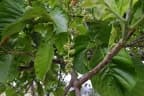
Sandoricum koetjape
Sandoricum koetjape
Safety & Hazards
None known
Cultivation Details
Santol is a plant of the hot, wet tropical lowlands[1], and cannot be grown above 1,000 metres in Java[2]. It flourishes in dry as well as moist areas of the Philippine lowlands[2]. Large trees can tolerate occasional light frosts[1]. The mean annual rainfall should lie in the range of 950 - 5,000mm, preferrably spread through the year but tolerant of a dry season of 2 - 5 months[3]. The temperatures during the hot season is best around 32 - 35°c, in the cold season from 18 - 22°c, but not below 16°c[3]. Prefers a position in full sun, but tolerant of some shade[4, 1, 3]. Prefers a fertile, well-drained, medium-acid soil, succeeding in clay loams, sandy clay loams with plenty of organic matter, limestone soils, volcanic soils and podsolic soils[4, 1, 3]. Plants are wind tolerant[3]. Trees commence flowering about 5 - 7 years after germinating[2]. Clonally propagated trees may flower after 3 - 4 years[2]. There are several named varieties, developed for their superior fruits[5]. Two 30 year old trees, in a botanic gardens, that had never fruited were put under stress by pounding large, heavy stones into the narrow forks of the main limbs - their first crops followed soon after[4].
Propagation
Seed - best sown as soon as it is ripe since they have a short viability[2]. Freshly sown, they have a germination rate of 90-95% in 16-31 days[2]. Seeds grow away quickly[2]. Budding. Air layering. Cite as: Tropical Plants Database, Ken Fern. tropical.theferns.info. 2026-02-20. <tropical.theferns.info/viewtropical.php?id=Sandoricum+koetjape>
Pollinators
Data unavailable
References
- [1]Perennial Edible Fruits of the Tropics : an Inventory — Martin, F. W.; Campbell, C. W.; Rubertbe, R. M. · U.S. Dept. of Agriculture, Agricultural Research Service · 1987 ↩︎A booklet giving terse details of almost 300 species of edible fruits, plus regional lists of Botanical and Common names for over 2,500 less well-known edible fruits of the tropics.
- [2]World Agroforesty Centre — http://www.worldagroforestry.org/ ↩︎An excellent online database of a huge range of trees giving very good information on each plant - its uses, ecology, identity, propagation, pests etc.
- [3]Digital Compendium of Forestry Species of Cambodia — www.digitalspecies.blogspot.com; Phnom Penh · 2008 · http://www.digitalspecies.blogspot.com ↩︎A very detailed booklet, produced in PDF format on the internet, giving information on around 100 species of trees.
- [4]Tropical and Subtropical Trees - A Worldwide Encyclopaedic Guide. — Barwick. M. · Thames & Hudson, London · 2004 · ISBN 0-500-51181-0 ↩︎A superb book, very concise and well written, giving a wealth of information on 400 or more species including descriptions, habitat, cultivation details and plant uses. A wealth of colour photographs bring each plant vividly to life.
- [5]Cornucopia II — Facciola. S. · Kampong Publications, California. · 1998 · ISBN 0-9628087-2-5 ↩︎The second edition of an excellent guide to the edible uses of plants, though it does not give any details of cultivation etc.
- [6]The Useful Plants of the Island of Guam — Safford W.E. · Smithsonian Institute; Washington. · 1905 · http://www.biodiversitylibrary.org/ ↩︎A very comprehensive, if rather dated, guide to the plants of Guam. It can be downloaded from the Internet.
- [7]Dictionary of Economic Plants. — Uphof. J. C. Th. · Weinheim · 1959 · ISBN - ↩︎An excellent and very comprehensive guide but it only gives very short descriptions of the uses without any details of how to utilize the plants. Not for the casual reader.