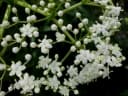
Sambucus javanica
Sambucus javanica
Safety & Hazards
Although no specific mention has been seen for this species, the leaves and stems of some, if not all, members of this genus are poisonous[1, 2]. The fruit of many species (although no records have been seen for this species) has been known to cause stomach upsets to some people. Any toxin the fruit might contain is liable to be of very low toxicity and is destroyed when the fruit is cooked[3, 2].
Cultivation Details
We have very little information on this species and do not know if it will be hardy in Britain, though judging by its native range it is only likely to be hardy outdoors in the mildest areas of the country. There is some confusion over the true identity of this plant. Some authorities suggest that this name is a synonym of S. chinensis, and we also have two different authors for the name of this species, the name mentioned above, from [4], and also Blume, which is mentioned in [5]. The following notes are based on the general needs of the genus. Tolerates most soils, including chalk[6], but prefers a moist loamy soil[7, 6]. Tolerates some shade but is best in a sunny position[7]. Tolerates atmospheric pollution and coastal situations[6]. Plants in this genus are notably resistant to honey fungus[6].
Propagation
Seed - best sown as soon as it is ripe in the autumn in a cold frame, when it should germinate in early spring. Stored seed can be sown in the spring in a cold frame but will probably germinate better if it is given 2 months warm followed by 2 months cold stratification first[8, 9, 10]. Prick out the seedlings into individual pots when they are large enough to handle. If good growth is made, the young plants can be placed in their permanent positions during the early summer. Otherwise, either put them in a sheltered nursery bed, or keep them in their pots in a sheltered position and plant them out in spring of the following year. Cuttings of half-ripe wood, 7 - 10cm with a heel, mid summer in a frame[8]. Cuttings of mature wood of the current season's growth, 15 - 20cm with a heel, late autumn in a frame or a sheltered outdoor bed[8]. Cite as: Temperate Plants Database, Ken Fern. temperate.theferns.info. 2026-02-21. <temperate.theferns.info/plant/Sambucus+javanica>
Pollinators
Insects
References
- [1]Edible and Medicinal Plants. — Launert. E. · Hamlyn · 1981 · ISBN 0-600-37216-2 ↩︎Covers plants in Europe. a drawing of each plant, quite a bit of interesting information.
- [2]Poisonous Plants in Britain and their Effects on Animals and Man. — Cooper. M. and Johnson. A. · HMSO · 1984 · ISBN 0112425291 ↩︎Concentrates mainly on the effects of poisonous plants to livestock.
- [3]A Colour Atlas of Poisonous Plants. — Frohne. D. and Pfänder. J. · Wolfe · 1984 · ISBN 0723408394 ↩︎Brilliant. Goes into technical details but in a very readable way. The best work on the subject that I've come across so far.
- [4]A Barefoot Doctors Manual. — ? · Running Press; Philadelphica. · 1977 · ISBN 0-914294-92-X ↩︎A very readable herbal from China, combining some modern methods with traditional chinese methods.
- [5]A Manual of Indian Timbers. — Gamble. J. S. · Bishen Singh Mahendra Pal Singh · 1972 · ISBN - ↩︎First written in the 19th century, but still a classic, giving a lot of information on the uses and habitats of Indian trees. Not for the casual reader.
- [6]The New RHS Dictionary of Gardening. 1992. — Huxley. A. · MacMillan Press · 1992 · ISBN 0-333-47494-5 ↩︎Excellent and very comprehensive, though it contains a number of silly mistakes. Readable yet also very detailed.
- [7]RHS Dictionary of Plants plus Supplement. 1956 — F. Chittendon. · Oxford University Press · 1951 · ISBN - ↩︎Comprehensive listing of species and how to grow them. Somewhat outdated, it has been replaced in 1992 by a new dictionary (see [ 200 ]).
- [8]Propagation of Trees, Shrubs and Conifers. — Sheat. W. G. · MacMillan and Co · 1948 · ISBN - ↩︎A bit dated but a good book on propagation techniques with specific details for a wide range of plants.
- [9]Seed Manual for Ornamental Trees and Shrubs. — Gordon. A. G. and Rowe. D. C. F. · HMSO; London · 1982 · ISBN 0-11-710152-4 ↩︎Very comprehensive guide to growing trees and shrubs from seed. Not for the casual reader.
- [10]The Reference Manual of Woody Plant Propagation. — Dirr. M. A. and Heuser. M. W. · Athens Ga. Varsity Press · 1987 · ISBN 0942375009 ↩︎A very detailed book on propagating trees. Not for the casual reader.
- [11]Cornucopia - A Source Book of Edible Plants. — Facciola. S. · Kampong Publications · 1990 · ISBN 0-9628087-0-9 ↩︎Excellent. Contains a very wide range of conventional and unconventional food plants (including tropical) and where they can be obtained (mainly N. American nurseries but also research institutes and a lot of other nurseries from around the world.
- [12]Medicinal Plants of China — Duke. J. A. and Ayensu. E. S. · Reference Publications, Inc. · 1985 · ISBN 0-917256-20-4 ↩︎Details of over 1,200 medicinal plants of China and brief details of their uses. Often includes an analysis, or at least a list of constituents. Heavy going if you are not into the subject.
- [13]Glossary of Indian Medicinal Plants (Including the Supplement). — Chopra. R. N., Nayar. S. L. and Chopra. I. C. · Council of Scientific and Industrial Research, New Delhi. · 1986 · ISBN - ↩︎Very terse details of medicinal uses of plants with a wide range of references and details of research into the plants chemistry. Not for the casual reader.