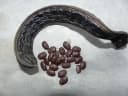
Samanea saman
Samanea saman
Safety & Hazards
None known
Cultivation Details
A plant of the lowland, humid tropics, growing from sea level to an elevation of 1,300 metres[1]. It prefers a mean annual temperature in the range 20 - 35°c, being liable to damage if temperatures ever drop below 8°c. It tolerates a mean annual rainfall in the range 600 - 3,000mm[1]. In areas of high rainfall the tree has a tendency to be shallow-rooted, but is deep rooted when grown in drier areas[1]. Prefers a position in full sun[2]. A fairly easy tree to grow, tolerant of a range of conditions, it grows on light or heavy soils and tolerates infertile or waterlogged conditions[1]. Normally found on neutral to moderately acid soils, it can grow on soil with pH as low as 4.6[1]. Established plants are very drought tolerant[2]. Samanea saman possesses some of the characters of other species known to have become invasive - these include. prolific seeding; livestock as effective dispersers of seed; nitrogen fixation; and adaptation to a variety of soil types. However, reference sources are somewhat conflicting as to the degree of naturalization and invasion, especially where it spreads on disturbed sites often in Pacific and Caribbean islands. The species is generally considered to be only moderately invasive[3]. The tree is listed as undesirable in environmentally sensitive areas of Australia[2]. The tree grows slowly in the first year of planting, but is generally considered to be fast growing with annual height increases of up to 150cm recorded for young trees[4, 5]. It responds to pruning and coppices well, regrowing rapidly when lopped or pollarded[1]. Yields of up to 275 kilos of pods per year can be obtained from trees 15 years old[6]. The trees provide a microclimate effect for the plants growing under their canopies. At night and on cloudy days, branches hang down and the leaves fold down and inward, allowing rain to fall directly on the ground and promoting cooling through exposing the ground[1]. In the morning the leaves unfold and resume a horizontal position, giving full shade and helping to preserve moisture[1]. The species is used as a shade for tea, coffee, cocoa, nutmeg and vanilla, and provides shade for pasture and grazing animals[1]. This species has a symbiotic relationship with certain soil bacteria, these bacteria form nodules on the roots and fix atmospheric nitrogen. Some of this nitrogen is utilized by the growing plant but some can also be used by other plants growing nearby[7].
Propagation
Seed - stores well at ambient temperatures[8]. Fresh seed that is still moist usually germinates freely without pre-treatment[8]. Once the seedcoat has dried and hardened it needs to be treated to allow the ingress of moisture. This can be dome by carefully making a nick in the seedcoat (being careful not to damage the seed) or soaking larger quantities of seed in hot water for 3 minutes. In either case, the seed is then soaked for 12 - 24 hours in warm water before sowing[8]. Treated seed usually germinates quickly, in 6 - 8 days under optimal conditions[8]. Cuttings. Cite as: Tropical Plants Database, Ken Fern. tropical.theferns.info. 2026-02-20. <tropical.theferns.info/viewtropical.php?id=Samanea+saman>
Pollinators
Bees, Lepidoptera
References
- [1]World Agroforesty Centre — http://www.worldagroforestry.org/ ↩︎An excellent online database of a huge range of trees giving very good information on each plant - its uses, ecology, identity, propagation, pests etc.
- [2]Tropical and Subtropical Trees - A Worldwide Encyclopaedic Guide. — Barwick. M. · Thames & Hudson, London · 2004 · ISBN 0-500-51181-0 ↩︎A superb book, very concise and well written, giving a wealth of information on 400 or more species including descriptions, habitat, cultivation details and plant uses. A wealth of colour photographs bring each plant vividly to life.
- [3]Invasive Species Compendium — http://www.cabi.org ↩︎An immense resource - in depth information on over 900 species of invasive plants (it also has information on animals, fungi etc).
- [4]Plant Resources of Southeast Asia — http://proseanet.org/ ↩︎Lots of information on the uses of the plants of SE Asia.
- [5]Traditional Trees of Pacific Islands — Elevitch. Craig. R. (Editor) · Permanent Agriculture Resources, Hawaii · 2006 · ISBN 0970254458 ↩︎Beautifully produced book with superb photos and detailed information on over 50 species of useful plants of the Pacific Islands.
- [6]Handbook of Energy Crops — Duke. J. · - · 1983 · https://hort.purdue.edu/newcrop/duke_energy/dukeindex.html · ISBN - ↩︎Published only on the Internet, excellent information on a wide range of both temperate and tropical plants.
- [7]Nodulation Plants in GRIN Taxonomy — United States Department of Agriculture · http://www.ars-grin.gov/~sbmljw/cgi-bin/taxnodul.pl?language=en ↩︎An online database listing plants that have either positive or negative reports on root and stem nodulation with nitrogen-fixing bacteria.
- [8]Seed Leaflets — Various · Forest & Landscape. Denmark · http://en.sl.life.ku.dk/Publikationer/Udgivelser/PopulaerPublikationer.aspx?katid={D28373CC-6EF3-4EF8-B097-6D83FABF209E}&serieid={9F1C3DB1-6E7B-4CF1-AF53-F480B0CB40EF}&sort=title ↩︎A series of leaflets, jointly produced by the University of Copenhagen and the Royal Botanic Gardens at Kew, focussing on seed information for a number species, but also giving a lot of other information about each plant.
- [9]Trees Commonly Cultivated in SE Asia — Jensen. M. · FAO Regional Office, Bangkok. · 1999 · ISBN 974-89377-5-5 ↩︎
- [10]Philippine Medicinal Plants — http://www.stuartxchange.org/CompleteList.html ↩︎A lovely site, giving brief details on the medicinal uses of several hundred (over 400 at the last count) plants in the Philippines, plus a picture of each plant.
- [11]Digital Compendium of Forestry Species of Cambodia — www.digitalspecies.blogspot.com; Phnom Penh · 2008 · http://www.digitalspecies.blogspot.com ↩︎A very detailed booklet, produced in PDF format on the internet, giving information on around 100 species of trees.