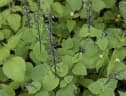
Salvia tiliifolia
Salvia tiliifolia
Safety & Hazards
None known
Cultivation Details
Salvia tiliifolia has a wide native range from the tropical Andes of South America, where it can be found at elevations up to 2,800 metres, to the warm temperate climate of Texas. It is not very frost-tolerant, often behaving as an annual plant in areas of its range with colder winters. Requires a very well-drained light sandy soil in a sunny position[1]. Prefers a rich soil[2]. Plants can be killed by excessive winter wet[1]. Members of this genus are rarely if ever troubled by browsing deer[3]. Sometimes cultivated as an ornamental, it can be grown as an annual, in areas where the summer growing season is long enough, flowering and seeding in its first year, if started in a greenhouse in the spring.
Propagation
Seed - sow early to mid spring in a greenhouse[1]. Germination should take place in about 2 weeks. Prick out the seedlings into individual pots when they are large enough to handle and plant them out into their permanent positions in late spring or early summer. Cuttings of half-ripe wood succeed at almost any time in the growing season[1]. Cite as: Temperate Plants Database, Ken Fern. temperate.theferns.info. 2026-02-21. <temperate.theferns.info/plant/Salvia+tiliifolia>
Pollinators
Bees, Butterflies
References
- [1]The New RHS Dictionary of Gardening. 1992. — Huxley. A. · MacMillan Press · 1992 · ISBN 0-333-47494-5 ↩︎Excellent and very comprehensive, though it contains a number of silly mistakes. Readable yet also very detailed.
- [2]RHS Dictionary of Plants plus Supplement. 1956 — F. Chittendon. · Oxford University Press · 1951 · ISBN - ↩︎Comprehensive listing of species and how to grow them. Somewhat outdated, it has been replaced in 1992 by a new dictionary (see [ 200 ]).
- [3]Perennial Garden Plants — Thomas. G. S. · J. M. Dent & Sons, London. · 1990 · ISBN 0 460 86048 8 ↩︎A concise guide to a wide range of perennials. Lots of cultivation guides, very little on plant uses.
- [4]Flora of Guatemala — Standley P.C. & J. A. Steyermark · 1946 - 1976 · http://www.archive.org/ ↩︎A superb reference, though somewhat dated. Gives lots of plant uses as well as information on plant habit and habitat. The entire flora (13 volumes) can now be downloaded from http://www.archive.org/
- [5]Dictionary of Economic Plants. — Uphof. J. C. Th. · Weinheim · 1959 · ISBN - ↩︎An excellent and very comprehensive guide but it only gives very short descriptions of the uses without any details of how to utilize the plants. Not for the casual reader.
- [6]Cornucopia II — Facciola. S. · Kampong Publications, California. · 1998 · ISBN 0-9628087-2-5 ↩︎The second edition of an excellent guide to the edible uses of plants, though it does not give any details of cultivation etc.
- [7]Mansfeld's Database of Agricultural and Horticultural Plants — http://mansfeld.ipk-gatersleben.de/pls/htmldb_pgrc/f?p=185:3:4292127278597336 ↩︎Terse details of a huge range of useful plants.
- [8]Cornucopia - A Source Book of Edible Plants. — Facciola. S. · Kampong Publications · 1990 · ISBN 0-9628087-0-9 ↩︎Excellent. Contains a very wide range of conventional and unconventional food plants (including tropical) and where they can be obtained (mainly N. American nurseries but also research institutes and a lot of other nurseries from around the world.
- [9]A Dictionary of Plants Used by Man. — Usher. G. · Constable · 1974 · ISBN 0094579202 ↩︎Forget the sexist title, this is one of the best books on the subject. Lists a very extensive range of useful plants from around the world with very brief details of the uses. Not for the casual reader.