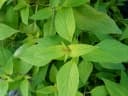
Salvia elegans
Salvia elegans
Safety & Hazards
None known
Cultivation Details
Salvia elegans is found from moderate elevations in the tropics of central America to the subtropical climate of northern Mexico. It is usually found at elevations above 1,700 metres. The plant tolerates temperatures down to between -5 and -10°c and can be grown outdoors in the warmer regions of the temperate zone[1]. Even in milder regions of the temperate zone, however, the top growth of this plant will usually be cut back to the ground in cold winters but, if the roots are given a good mulch in the autumn, plants will often survive the winter outdoors and resprout freely from the base in the spring[1]. Requires a very well-drained light sandy soil in a warm sunny position[1]. Prefers a rich soil[2]. Plants can be killed by excessive winter wet[1]. This species comes into bloom in the autumn and early winter, and requires frost-free conditions at this time if it is to succeed[3]. The species is of unknown origin, but is thought to be a horticultural form of the ornamental red sage (Salvia splendens[4]) There are some named varieties. 'Scarlet Pineapple' has leaves with a pineapple-like scent[5]. Members of this genus are rarely if ever troubled by browsing deer[6].
Propagation
Seed - sow early to mid spring in a greenhouse[1]. Germination usually takes place within 2 weeks. Prick out the seedlings into individual pots when they are large enough to handle and plant them out in early summer. In areas where the plant is towards the limits of its hardiness, it is best to grow the plants on in a greenhouse for their first winter and plant them out in late spring of the following year. Cuttings of half-ripe wood succeed at almost any time in the growing season[1]. Cite as: Temperate Plants Database, Ken Fern. temperate.theferns.info. 2026-02-21. <temperate.theferns.info/plant/Salvia+elegans>
Pollinators
Bees, Humming birds
References
- [1]The New RHS Dictionary of Gardening. 1992. — Huxley. A. · MacMillan Press · 1992 · ISBN 0-333-47494-5 ↩︎Excellent and very comprehensive, though it contains a number of silly mistakes. Readable yet also very detailed.
- [2]RHS Dictionary of Plants plus Supplement. 1956 — F. Chittendon. · Oxford University Press · 1951 · ISBN - ↩︎Comprehensive listing of species and how to grow them. Somewhat outdated, it has been replaced in 1992 by a new dictionary (see [ 200 ]).
- [3]A Book of Salvias - Sages for Every Garden — Clebsch B. · Timber Press Inc.; Oregon. · 1997 · ISBN 0-88192-369-9 ↩︎Fairly detailed information on over 100 species of Salvia that are grown as ornamentals.
- [4]Mansfeld's Database of Agricultural and Horticultural Plants — http://mansfeld.ipk-gatersleben.de/pls/htmldb_pgrc/f?p=185:3:4292127278597336 ↩︎Terse details of a huge range of useful plants.
- [5]Encyclopaedia of Herbs and their Uses. — Bown. D. · Dorling Kindersley, London. · 1995 · ISBN 0-7513-020-31 ↩︎A very well presented and informative book on herbs from around the globe. Plenty in it for both the casual reader and the serious student. Just one main quibble is the silly way of having two separate entries for each plant.
- [6]Perennial Garden Plants — Thomas. G. S. · J. M. Dent & Sons, London. · 1990 · ISBN 0 460 86048 8 ↩︎A concise guide to a wide range of perennials. Lots of cultivation guides, very little on plant uses.
- [7]Cornucopia II — Facciola. S. · Kampong Publications, California. · 1998 · ISBN 0-9628087-2-5 ↩︎The second edition of an excellent guide to the edible uses of plants, though it does not give any details of cultivation etc.
- [8]CosIng — http://ec.europa.eu/growth/tools-databases/cosing/ ↩︎CosIng is the European Commission database for information on cosmetic substances and ingredients.
- [PFAF]Plants for a Future — pfaf.org ↩︎