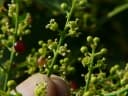
Salvadora persica
Salvadora persica
Safety & Hazards
None known
Cultivation Details
A plant of drier to arid areas in the tropics and subtropics, where it is found at elevations up to 1,800 metres. It grows best in areas where annual daytime temperatures are within the range 15 - 30°c, but can tolerate 12 - 42°c[1]. It prefers a mean annual rainfall in the range 300 - 700mm, but tolerates200 - 1,500 mm[1]. Prefers a well-drained, seasonally moist to wet soil in a sunny position[2]. Prefers clay soils but is also found on loams, black soils and sand[1]. Highly salt tolerant, it can grow on coastal regions and inland saline soils[3, 1]. Adapted to alkaline or very saline soils, usually clay-rich, and soils without salt[1]. Prefers a pH in the range 7 - 8, tolerating 6.5 - 8.5[1]. Established plants are very drought resistant[4]. Tolerant of maritime winds[1]. Generally a slow-growing tree[5].
Propagation
Seed - Cuttings of half-ripe wood rooted in a sandy medium[2]. Cite as: Tropical Plants Database, Ken Fern. tropical.theferns.info. 2026-02-20. <tropical.theferns.info/viewtropical.php?id=Salvadora+persica>
Pollinators
Bees
References
- [1]Ecocrop — http://ecocrop.fao.org/ecocrop/srv/en/home ↩︎Basic information on a wide range of useful plants, plus details of environmental needs where available.
- [2]Encyclopaedia of Herbs and their Uses. — Bown. D. · Dorling Kindersley, London. · 1995 · ISBN 0-7513-020-31 ↩︎A very well presented and informative book on herbs from around the globe. Plenty in it for both the casual reader and the serious student. Just one main quibble is the silly way of having two separate entries for each plant.
- [3]Flora Zambesiaca — http://apps.kew.org/efloras/fz/intro.html ↩︎An excellent online flora of plants from the Zambezi River basin. It lists a number of the plant uses as well as the habitats and botanical descriptions of the plants.
- [4]Edible Wild Plants of Tanzania — Ruffo, C.K.: Birnie, A. & Tengnas, B. · Regional Land Management Unit; Nairobi. · 2002 · ISBN 9966-896-60-0 ↩︎A very well presented, simple guide to growing and utilizing wild food plants in Tanzania, with line drawings of each plant, a description, habitat and range, non-food as well as food uses, plus basic information on growing the plants.
- [5]World Agroforesty Centre — http://www.worldagroforestry.org/ ↩︎An excellent online database of a huge range of trees giving very good information on each plant - its uses, ecology, identity, propagation, pests etc.
- [6]Trees and Shrubs of the Sahel. Their Characteristics and Uses. — von Maydell H. · Deutsche Gesellschaft fur Technische Zusammenarbeit; Germany · 1990 · ISBN 3-8236-1198-4 ↩︎A well-researched book, usually with more than one photograph of each species and good information on the plant and its uses.
- [7]Mansfeld's Database of Agricultural and Horticultural Plants — http://mansfeld.ipk-gatersleben.de/pls/htmldb_pgrc/f?p=185:3:4292127278597336 ↩︎Terse details of a huge range of useful plants.
- [8]The New RHS Dictionary of Gardening. 1992. — Huxley. A. · MacMillan Press · 1992 · ISBN 0-333-47494-5 ↩︎Excellent and very comprehensive, though it contains a number of silly mistakes. Readable yet also very detailed.
- [9]Dictionary of Economic Plants. — Uphof. J. C. Th. · Weinheim · 1959 · ISBN - ↩︎An excellent and very comprehensive guide but it only gives very short descriptions of the uses without any details of how to utilize the plants. Not for the casual reader.
- [10]Cornucopia II — Facciola. S. · Kampong Publications, California. · 1998 · ISBN 0-9628087-2-5 ↩︎The second edition of an excellent guide to the edible uses of plants, though it does not give any details of cultivation etc.
- [11]Annals of the Missouri Botanical Garden Vol. 65 — Missouri Botanical Garden · 1978 ↩︎An excellent botanical publication, available for download from the Internet. This volume contains parts of the Flora of Panama.
- [12]BoDD (Botanical Dermatology Database) — http://bodd.cf.ac.uk/ ↩︎Brief notes on a very wide range of plants that have reports of causing harm to the skin.
- [13]Flora of Pakistan — http://www.efloras.org ↩︎As of 2006, there is not much information on habitats available, but it is being developed and promises to be an excellent resource.