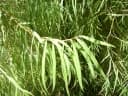
Salix humboldtiana
Salix humboldtiana
Safety & Hazards
None known
Cultivation Details
Salix humboldtiana has a very wide natural range from southern S. America to northern Mexico with a climate varying from temperate to tropical. It is usually found at higher elevations in the tropics, generally up to 2,000 metres[1]. The plant is not very cold-hardy, being able to tolerate short periods with temperatures falling to around -5°c. Requires a sunny position[2]. The plant is able to tolerate long periods with the soil inundated, in some areas it can be up to seven months with submerged roots[3]. Young plants establish well and grow away quickly[2]. The flowers are dioecious, male and female flowers being produced on separate plants. If seed is required then at least one plant of each sex need to be growing in reasonable proximity[4]. Hybridization in the genus is common, especially when species are brought together in cultivation[5]. Salix species are unusual in as much as, although they produce their flowers in catkins, these are insect rather than wind pollinated. Indeed, the flowers of many species are excellent sources of nectar for bees and other insects, especially valuable are those species that flower early in the growing season[4]. The roots of Salix species are often vigorous and extensive and can range some distance from the plant. Several species are known to cause problems by growing into drains and drainage systems as their roots seek out moisture[4]. Species in this genus are often notably susceptible to honey fungus[5].
Propagation
Willow seed is very small and light, and has a very short viability, perhaps as little as a few days in some species. It must be surface sown as soon as it is ripe. In nature the seed only germinates in disturbed soils in an open situation. In nursery conditions, sow the seed in a tray in a moderately sunny position and keep the soil moist. Germination is usually quite rapid - prick out the seedlings into individual pots when they are large enough to handle and grow on until large enough to plant out. Plants generally establish better if planted out whilst quite small. Cuttings of mature wood of the current year's growth or older can root at almost any time of the year, though late autumn is considered best as this produces a better balance of root and stem growth the following spring[6]. Plant them in a sheltered outdoor nursery bed or straight into their permanent position and give them a good weed-suppressing mulch. Most species are very easy. Plant into their permanent positions in the following autumn. Cuttings of half-ripe wood, early to mid summer in a frame. Very easy. Cite as: Temperate Plants Database, Ken Fern. temperate.theferns.info. 2026-02-21. <temperate.theferns.info/plant/Salix+humboldtiana>
Pollinators
Insects, Wind
References
- [1]Flora of Costa Rica — Standley P.C. · Field Museum of Natural History; Chicago · 1938 · http://www.archive.org/ ↩︎Rather dated, but an excellent treatment of the area. Available for download from the internet.
- [2]Brazilian Trees. Volume 1. 4th Edition. — Lorenzi. H. · Instituto Plantarum De Estudos Da Flora; Brazil. · 2002 · ISBN 85-86714-17-8 ↩︎Information on 350 species of Brazilian trees. Stunning photographs of each species, brief details on the plant, its uses and how to grow it from seed. A superb work, with the minor irritation that the translation from Portuguese is not of the best.
- [3]IUCN Red List of Threatened Species — http://www.iucnredlist.org/ ↩︎A list of plants under threat and facing possible extinction, usually with brief details of the threats and information on habitat.
- [4]Trees and Shrubs Hardy in Great Britain. Vol 1 - 4 and Supplement. — Bean. W. · Murray · 1981 · ISBN - ↩︎A classic with a wealth of information on the plants, but poor on pictures.
- [5]The New RHS Dictionary of Gardening. 1992. — Huxley. A. · MacMillan Press · 1992 · ISBN 0-333-47494-5 ↩︎Excellent and very comprehensive, though it contains a number of silly mistakes. Readable yet also very detailed.
- [6]New Trees — Grimshaw J.; Bayton R.; Wilks H. · Kew Publishing; London · 2009 · ISBN 1842461737 ↩︎Provides comprehensive botanical descriptions and horticultural commentary on over 800 tree species that have been introduced to cultivation in recent decades.
- [7]Flora of Guatemala — Standley P.C. & J. A. Steyermark · 1946 - 1976 · http://www.archive.org/ ↩︎A superb reference, though somewhat dated. Gives lots of plant uses as well as information on plant habit and habitat. The entire flora (13 volumes) can now be downloaded from http://www.archive.org/
- [8]South American Timbers: the Properties, Uses and Characteristics of 190 Species. — Bolza. E. & Christensen. F.J. · Commonwealth Scientific and Industrial Research Organization · 1979 · ISBN 0 643 02582 0 ↩︎A very useful guide.
- [9]Mansfeld's Database of Agricultural and Horticultural Plants — http://mansfeld.ipk-gatersleben.de/pls/htmldb_pgrc/f?p=185:3:4292127278597336 ↩︎Terse details of a huge range of useful plants.
- [10]Flora del Valle de Tehuacán-Cuicatlán — Universidad Nacional Autónoma de México · 1993 - 2015 · http://www.biodiversitylibrary.org/bibliography/118975#/summary · ISBN 968-36-3108-8 ↩︎An excellent flora (in Spanish) of the Tehuacán-Cuicatlán biosphere reserve in southeastern Mexico. It can be downloaded from the Internet
- [11]Discovering Wild Plants - Alaska, W. Canada and the Northwest. — Schofield. J. J. · Alaska Northwest Books; Alaska · 2003 · ISBN 0882403699 ↩︎A nice guide to some useful plants in that area.
- [12]BoDD (Botanical Dermatology Database) — http://bodd.cf.ac.uk/ ↩︎Brief notes on a very wide range of plants that have reports of causing harm to the skin.
- [13]Encyclopaedia of Herbs and their Uses. — Bown. D. · Dorling Kindersley, London. · 1995 · ISBN 0-7513-020-31 ↩︎A very well presented and informative book on herbs from around the globe. Plenty in it for both the casual reader and the serious student. Just one main quibble is the silly way of having two separate entries for each plant.
- [14]Dictionary of Economic Plants. — Uphof. J. C. Th. · Weinheim · 1959 · ISBN - ↩︎An excellent and very comprehensive guide but it only gives very short descriptions of the uses without any details of how to utilize the plants. Not for the casual reader.
- [PFAF]Plants for a Future — pfaf.org ↩︎