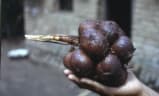
Salacca zalacca
Salacca zalacca
Safety & Hazards
None known
Cultivation Details
A plant of the humid, lowland tropics, where it is found at elevations up to 500 metres. It grows best in areas where annual daytime temperatures are within the range 22 - 30°c, but can tolerate 12 - 36°c[1]. It prefers a mean annual rainfall in the range 1,700 - 3,100mm, but tolerates 1,400 - 3,500mm[1]. Requires a deep, rich, moist soil and some shade[2]. Prefers a light-textured soil[1]. Young palms require heavy shade which may be reduced after about one year[2]. Because of its superficial root system, the palm requires a high water table, rain or irrigation during most of the year, but it does not stand flooding[2]. Prefers a pH in the range 5 - 6, tolerating 4.5 - 6.5[1]. The palm starts flowering three to four years after sowing[2]. It can be productive for 50 years or more[2]. The scarce data available suggest that annual yields vary from 5 - 15 t/ha[2]. There are some named varieties[3]. A dioecious plant, requiring both male and female forms to be grown near each other if fruit and seed are required[4]. One male plant is usually adequate to fertilise nine females[4]. There is at least one monoecious variety[2]. 'Bali' produces inflorescences with both hermaphrodite and staminate flowers; the latter produce functional pollen[2].
Propagation
Seed - pre-soak for 24 hours in warm water and sow in containers[5]. The seed needs to be fresh, it takes 2 - 3 months to germinate[5]. The seeds are sown directly in the field (2-5 seeds together in 5 cm deep holes) or in nursery beds. The seedlings are planted out in the field during the rainy season when they are a few months old[2]. Germination becomes visible when the cylindrical embryo-containing plug is extruded through the germpore at the kernel's apex. A radicle soon emerges from the tip of the plug and the shoot, a main root and several secondary roots emerge from the sides of this plug. About 60-90 days after sowing the first complete leaf, bifid and some 20-30 cm long, is fully expanded, the seedling still being firmly attached to the kernel[2]. Division of suckers[6]. Cite as: Tropical Plants Database, Ken Fern. tropical.theferns.info. 2026-02-20. <tropical.theferns.info/viewtropical.php?id=Salacca+zalacca>
Pollinators
Insects
References
- [1]Ecocrop — http://ecocrop.fao.org/ecocrop/srv/en/home ↩︎Basic information on a wide range of useful plants, plus details of environmental needs where available.
- [2]World Agroforesty Centre — http://www.worldagroforestry.org/ ↩︎An excellent online database of a huge range of trees giving very good information on each plant - its uses, ecology, identity, propagation, pests etc.
- [3]Cornucopia II — Facciola. S. · Kampong Publications, California. · 1998 · ISBN 0-9628087-2-5 ↩︎The second edition of an excellent guide to the edible uses of plants, though it does not give any details of cultivation etc.
- [4]The New RHS Dictionary of Gardening. 1992. — Huxley. A. · MacMillan Press · 1992 · ISBN 0-333-47494-5 ↩︎Excellent and very comprehensive, though it contains a number of silly mistakes. Readable yet also very detailed.
- [5]Palms of the World — Blombery. A. & Rodd. T. · Angus and Robertson · 1992 · ISBN 0-207-14848-1 ↩︎An excellent guide, well illustrated, with information on cultivation, uses, habitat etc of almost 200 species of Palms.
- [6]Perennial Edible Fruits of the Tropics : an Inventory — Martin, F. W.; Campbell, C. W.; Rubertbe, R. M. · U.S. Dept. of Agriculture, Agricultural Research Service · 1987 ↩︎A booklet giving terse details of almost 300 species of edible fruits, plus regional lists of Botanical and Common names for over 2,500 less well-known edible fruits of the tropics.
- [7]Palm and Cycad Societies of Australia. — http://www.pacsoa.org.au/ ↩︎Contains at least a little information on the majority of palm and cycad species, plus a wealth of photographs. A first class website.