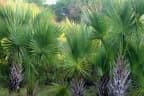
Sabal mexicana
Sabal mexicana
Safety & Hazards
None known
Cultivation Details
Sabal mexicana succeeds in moist tropical climates where temperatures never fall below 10°c, the average annual rainfall is 1,500mm or more and the driest month has 25mm or more rain[1]. It can also grow in the drier tropics with rainfall below 1,000mm[1]. Plants can also succeed in drier areas with an annual rainfall as low as 250mm and one month or more where rainfall is below 25mm[1]. Plants from the north of its range (in Texas) have a reasonably marginal frost-tolerance and might be suitable for growing outdoors in the very mildest areas of the temperate zone[2]. Succeeds in most fertile moist but well-drained soils in a sheltered sunny position[3, 4, 2]. Although it prefers a humid atmosphere, this species is tolerant of arid atmospheres so long as it has plenty of moisture available at the roots[2]. Plants grow well in full sun, even when small[1]. Plants can tolerate at least some maritime exposure with salt spray and somewhat saline soil conditions[1]. Palms usually have deep penetrating root systems and generally establish best when planted out at a young stage. However, older plants are substantially more cold tolerant than juvenile plants[2]. In areas at the limit of their cold tolerance, therefore, it is prudent to grow the plants in containers for some years, giving them winter protection, and only planting them into their permanent positions when sheer size dictates[2]. This species can also be transplanted even when very large. Although the thick fleshy roots are easily damaged and/or desiccated, new roots are generally freely produced. It is important to stake the plant very firmly to prevent rock, and also to give it plenty of water until re-established - removing many of the leaves can also help[2]. A very variable plant in the wild[2].
Propagation
Seed - best sown as soon as it is ripe in a warm greenhouse at not less than 24°c[3]. Stored seed is very slow to germinate. Pre-soaking the seed for 24 hours in warm water prior to sowing may shorten the germination time. Plants form a long tap-root some time before forming a shoot. Germination of fresh seed usually takes place in 3 - 4 months at 25°c[5]. As soon as they are large enough to handle, prick the seedlings out into individual pots and grow them on in the greenhouse for at least their first two winters. Plant them out into their permanent positions in late spring or early summer, after the last expected frosts. Consider giving them some protection from the cold for at least their first winter outdoors. Cite as: Temperate Plants Database, Ken Fern. temperate.theferns.info. 2026-02-21. <temperate.theferns.info/plant/Sabal+mexicana>
Pollinators
Bees
References
- [1]Palms of the World — Blombery. A. & Rodd. T. · Angus and Robertson · 1992 · ISBN 0-207-14848-1 ↩︎An excellent guide, well illustrated, with information on cultivation, uses, habitat etc of almost 200 species of Palms.
- [2]Palms for Cooler Climates. — McMillan-Browse. P. · Trebah Enterprises. · 1993 · ISBN 0 9521952 0 8 ↩︎An excellent little booklet on the subject, though it does not mention many plant uses.
- [3]The RHS Gardener's Encyclopedia of Plants and Flowers — Brickell. C. · Dorling Kindersley Publishers Ltd. · 1990 · ISBN 0-86318-386-7 ↩︎Excellent range of photographs, some cultivation details but very little information on plant uses.
- [4]The New RHS Dictionary of Gardening. 1992. — Huxley. A. · MacMillan Press · 1992 · ISBN 0-333-47494-5 ↩︎Excellent and very comprehensive, though it contains a number of silly mistakes. Readable yet also very detailed.
- [5]Growing from Seed. Volume 3. — Bird. R. (Editor) · Thompson and Morgan. · 1989 · ISBN - ↩︎Very readable magazine with lots of information on propagation.
- [6]Flora of N. America — http://flora.huh.harvard.edu/fna/ ↩︎An on-line version of the flora with an excellent description of the plant including a brief mention of plant uses.
- [7]Flora of Guatemala — Standley P.C. & J. A. Steyermark · 1946 - 1976 · http://www.archive.org/ ↩︎A superb reference, though somewhat dated. Gives lots of plant uses as well as information on plant habit and habitat. The entire flora (13 volumes) can now be downloaded from http://www.archive.org/
- [8]Dictionary of Economic Plants. — Uphof. J. C. Th. · Weinheim · 1959 · ISBN - ↩︎An excellent and very comprehensive guide but it only gives very short descriptions of the uses without any details of how to utilize the plants. Not for the casual reader.
- [9]IUCN Red List of Threatened Species — http://www.iucnredlist.org/ ↩︎A list of plants under threat and facing possible extinction, usually with brief details of the threats and information on habitat.
- [10]Manual of the Trees of N. America. — Sargent. C. S. · Dover Publications Inc. New York. · 1965 · http://www.biodiversitylibrary.org/ · ISBN 0-486-20278-X ↩︎Two volumes, a comprehensive listing of N. American trees though a bit out of date now. Good details on habitats, some details on plant uses. Not really for the casual reader. It can be downloaded from the internet.
- [11]Cornucopia II — Facciola. S. · Kampong Publications, California. · 1998 · ISBN 0-9628087-2-5 ↩︎The second edition of an excellent guide to the edible uses of plants, though it does not give any details of cultivation etc.
- [12]Field Guide to the Palms of the Americas — Henderson A.; Galeano G.; Bernal R. · Princeton University Press; Princeton, New Jersey. · 1995 · ISBN 0-691-08537-4 ↩︎An excellent book, giving basic information on all the 550 species of palms native to the Americas that were known in 1995. Comprehensive information on the plants range and habitat, brief description, some uses and almost 250 photos.
- [13]The Complete Trees of N. America. Field Guide and Natural History. — Elias. T. · Van Nostrand Reinhold Co. · 1980 · ISBN 0442238622 ↩︎A very good concise guide. Gives habitats, good descriptions, maps showing distribution and a few of the uses. It also includes the many shrubs that occasionally reach tree proportions.
- [14]Economic Botany. — Hill. A. F. · The Maple Press · 1952 · ISBN - ↩︎Not very comprehensive, but it is quite readable and goes into some detail about the plants it does cover.
- [PFAF]Plants for a Future — pfaf.org ↩︎