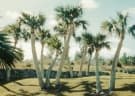
Arecaceae FAMILY Endangered
Sabal bermudana
Sabal bermudana
Edibility
0/5
Medicinal
0/5
Safety & Hazards
None known
Cultivation Details
HabitEvergreen Tree
GrowthSlow
Native to the subtropical islands of Bermuda, the plant can be cultivated in the tropics and warm temperate areas[1, 2]. Succeeds in full to part sun[3]. Prefers a well-drained soil[1, 3]. The plant is somewhat salt tolerant[3]. A slow-growing plant[4].
Propagation
Seed - Cite as: Tropical Plants Database, Ken Fern. tropical.theferns.info. 2026-02-20. <tropical.theferns.info/viewtropical.php?id=Sabal+bermudana>
Pollinators
Data unavailable
References
- [1]Palm and Cycad Societies of Australia. — http://www.pacsoa.org.au/ ↩︎Contains at least a little information on the majority of palm and cycad species, plus a wealth of photographs. A first class website.
- [2]Common Trees of Puerto Rico and the Virgin Islands — Little E.L.; Wadsworth F.H. · USDA, Forest Service; Washington. · 1964 ↩︎Contains detailed information, and usually an illustration, on 250 tree species, including both native and exotic species.
- [3]Tropical Flowering Plants. A Guide to Identification and Cultivation. — Llamas K.A. · Timber Press; Oregon. · 2003 · ISBN 0-88192-585-3 ↩︎A terse guide for the gardener to almost 1,500 species of ornamental tropical plants with brief details on their cultivation and, usually, a small photograph of good quality.
- [4]Monocotyledons and Gymnosperms of Puerto Rico and the Virgin Islands — Acevedo-Rodríguez P. & Strong M.T. (Editors) · Smithsonian Institution; Washington. · 2005 · http://www.biodiversitylibrary.org · ISBN 0097-1618 ↩︎A treatment of the monocots and gymnosperms growing in Puerto Rico and the Virgin Islands. It can be downloaded from the Internet.
- [5]Field Guide to the Palms of the Americas — Henderson A.; Galeano G.; Bernal R. · Princeton University Press; Princeton, New Jersey. · 1995 · ISBN 0-691-08537-4 ↩︎An excellent book, giving basic information on all the 550 species of palms native to the Americas that were known in 1995. Comprehensive information on the plants range and habitat, brief description, some uses and almost 250 photos.
- [6]IUCN Red List of Threatened Species — http://www.iucnredlist.org/ ↩︎A list of plants under threat and facing possible extinction, usually with brief details of the threats and information on habitat.