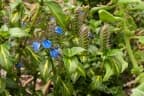
Rungia klossii
Rungia klossii
Safety & Hazards
None known
Cultivation Details
A plant of the moist tropics, where it is found mainly at elevations from 1,000 - 2,000 metres, though it can also be grown down to sea level[1]. It grows best in areas where annual daytime temperatures are within the range 12 - 17°c, but can tolerate 12 - 29°c[2]. It prefers a mean annual rainfall in the range 800 - 1,200mm, but tolerates 500 - 2,000mm[2]. Prefers a sunny position[2]. It prefers a reasonably fertile soil, preferably moist, but will grow in most soils[1]. Prefers a pH in the range 5.5 - 6.2, tolerating 5 - 7[2]. The plant grows reasonably slowly[1]. The shoot tips and upper leaves can be harvested from about 2 - 4 months after planting out, with harvesting continuing at 1 - 2 monthly intervals for 2 years or more[1]. Regular picking keeps the branches short and productive of leaves[1]. The tips are picked with 2 - 3 leaves on then, each tip weighing about 0.8g. Total yields can be 2 kg/plant/year. If the plants were spaced at 50cm spacing this would give a yield of 4 kg per square metre of garden[1].
Propagation
Seed - Stem cuttings. The plant is grown from cuttings which are about 25cm long. A clump of stems are sown together - these often already have roots developing from the nodes, or very quickly develop roots. It can be planted at any time of the year[1]. Cite as: Tropical Plants Database, Ken Fern. tropical.theferns.info. 2026-02-20. <tropical.theferns.info/viewtropical.php?id=Rungia+klossii>
Pollinators
Data unavailable
References
- [1]Food Plants of Papua New Guinea — French. B.R. · Author. · 2006 ↩︎Published on-line in PDF format, this book contains information on several hundred New Guinea food plants.
- [2]Ecocrop — http://ecocrop.fao.org/ecocrop/srv/en/home ↩︎Basic information on a wide range of useful plants, plus details of environmental needs where available.
- [3]Mansfeld's Database of Agricultural and Horticultural Plants — http://mansfeld.ipk-gatersleben.de/pls/htmldb_pgrc/f?p=185:3:4292127278597336 ↩︎Terse details of a huge range of useful plants.
- [4]Cornucopia II — Facciola. S. · Kampong Publications, California. · 1998 · ISBN 0-9628087-2-5 ↩︎The second edition of an excellent guide to the edible uses of plants, though it does not give any details of cultivation etc.
- [PFAF]Plants for a Future — pfaf.org ↩︎