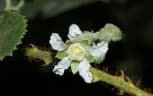
Rubus ellipticus
Rubus ellipticus
Safety & Hazards
None known
Cultivation Details
Rubus ellipticus is able to tolerate a variety of habitats from the warm temperate zone, where it experiences frosts, to tropical areas, where it is often found at higher elevations. Although found typically in sparsely colonized low rainfall sites in its native South and East Asia, it is also widely distributed through a variety of moisture habitats ranging from dry mountain slopes to the margins of lower and mid-elevation rice fields, whilst the var. obcordatus grows vigorously in wet lowland sites along pond banks, as well as in heavily forested to drier montane habitats at 1,000 - 2,500 metres up to 3,000 metres. In Hawaii, the only place to which it has been introduced where it has been recognized as a noxious weed, it occurs at about 1,300 metres elevation with an annual rainfall of 400mm[1]. Easily grown in a good well-drained loamy soil in sun or semi-shade[2, 3, 4]. Although fruiting best in a sunny position, this species is more shade tolerant than many other Rubus species[1]. When grown in warmer regions, this species can flower and fruit all year round[1]. Annual yields from wild plants in the Himalayas are about 750g from a plant occupying 2.5 square metres[5]. Plants in this genus are notably susceptible to honey fungus[4]. Root nodules from plants collected in Java showed nitrogenase activity and can be supposed to fix nitrogen under normal conditions[6].
Propagation
Seed - requires stratification and is best sown in early autumn in a cold frame. Stored seed requires one month stratification at about 3°c and is best sown as early as possible in the year. Prick out the seedlings when they are large enough to handle and grow on in a cold frame. Plant them out into their permanent positions in late spring of the following year. Cuttings of half-ripe wood, mid summer in a frame[4]. Tip layering in July. Plant out in autumn. Division in early spring or just before leaf-fall in the autumn[4]. Cite as: Temperate Plants Database, Ken Fern. temperate.theferns.info. 2026-02-21. <temperate.theferns.info/plant/Rubus+ellipticus>
Pollinators
Insects
References
- [1]Invasive Species Compendium — http://www.cabi.org ↩︎An immense resource - in depth information on over 900 species of invasive plants (it also has information on animals, fungi etc).
- [2]RHS Dictionary of Plants plus Supplement. 1956 — F. Chittendon. · Oxford University Press · 1951 · ISBN - ↩︎Comprehensive listing of species and how to grow them. Somewhat outdated, it has been replaced in 1992 by a new dictionary (see [ 200 ]).
- [3]Trees and Shrubs Hardy in Great Britain. Vol 1 - 4 and Supplement. — Bean. W. · Murray · 1981 · ISBN - ↩︎A classic with a wealth of information on the plants, but poor on pictures.
- [4]The New RHS Dictionary of Gardening. 1992. — Huxley. A. · MacMillan Press · 1992 · ISBN 0-333-47494-5 ↩︎Excellent and very comprehensive, though it contains a number of silly mistakes. Readable yet also very detailed.
- [5]Wild Fruits of the Sub-Himalayan Region. — Parmar. C. and Kaushal. M.K. · Kalyani Publishers. New Delhi. · 1982 · ISBN - ↩︎Contains lots of information on about 25 species of fruit-bearing plants of the Himalayas, not all of them suitable for cool temperate zones.
- [6]Flora Malesiana Series 1 — Various · Nationaal Herbarium Nederiand, Universiteit Leiden branch · http://www.archive.org ↩︎A massive treatment of the plants of the Malaysian Archipelago. Much of it has been made available to download from the Internet
- [7]Comfrey Report. — Hills. L. · Henry Doubleday Research Ass. ↩︎A small booklet giving a fairly comprehensive guide to the uses of comfrey.
- [8]Plants and People of Nepal — Manandhar. N. P. · Timber Press. Oregon. · 2002 · ISBN 0-88192-527-6 ↩︎Excellent book, covering over 1,500 species of useful plants from Nepal together with information on the geography and peoples of Nepal. Good descriptions of the plants with terse notes on their uses.
- [9]Dictionary of Economic Plants. — Uphof. J. C. Th. · Weinheim · 1959 · ISBN - ↩︎An excellent and very comprehensive guide but it only gives very short descriptions of the uses without any details of how to utilize the plants. Not for the casual reader.
- [10]Mansfeld's Database of Agricultural and Horticultural Plants — http://mansfeld.ipk-gatersleben.de/pls/htmldb_pgrc/f?p=185:3:4292127278597336 ↩︎Terse details of a huge range of useful plants.
- [11]Flowers of the Himalayas. — Polunin. O. and Stainton. A. · Oxford Universtiy Press · 1984 · ISBN - ↩︎A very readable and good pocket guide (if you have a very large pocket!) to many of the wild plants in the Himalayas. Gives many examples of plant uses.
- [12]Flora of China — Missouri Botanical Garden Press; St. Louis. · 1994 · http://flora.huh.harvard.edu/china/ ↩︎An excellent, comprehensive resource in 25 volumes. In addition to the botanical information the flora also gives basic information on habitat and some uses. An on-line version is also available.
- [13]Cornucopia - A Source Book of Edible Plants. — Facciola. S. · Kampong Publications · 1990 · ISBN 0-9628087-0-9 ↩︎Excellent. Contains a very wide range of conventional and unconventional food plants (including tropical) and where they can be obtained (mainly N. American nurseries but also research institutes and a lot of other nurseries from around the world.
- [14]A Manual of Indian Timbers. — Gamble. J. S. · Bishen Singh Mahendra Pal Singh · 1972 · ISBN - ↩︎First written in the 19th century, but still a classic, giving a lot of information on the uses and habitats of Indian trees. Not for the casual reader.
- [15]Forest Flora of Chakrata, Dehra Dun and Saharanpur. — Gupta. B. L. · Forest Research Institute Press · 1945 · ISBN - ↩︎A good flora for the middle Himalayan forests, sparsly illustrated. Not really for the casual reader.
- [16]Minor Products of Philippine Forests — Brown. W. H. · Bureau of Forestry, Manilla. · 1920 ↩︎A useful guide to some of the plants of the area, though terse on details. The book is out of copyright and can be legally downloaded from the Internet.
- [17]Antioxidant activity of selected lesser known edible fruits from western ghats of India — Karuppusamy S.; Muthuraja G.; Rajasekaran K.M. · 2011 ↩︎
- [18]Flowers of India — http://www.flowersofindia.net/ ↩︎A wed site of native Indian plants, plus cultivated and naturalized species. It has good quality photos and terse details on more than 3,000 species and cultivars.
- [19]Plant Resources of Southeast Asia — http://proseanet.org/ ↩︎Lots of information on the uses of the plants of SE Asia.
- [20]Tibetan Medicinal Plants — Tsarong. Tsewang. J. · Tibetan Medical Publications, India · 1994 · ISBN 81-900489-0-2 ↩︎A nice little pocket guide to the subject with photographs of 95 species and brief comments on their uses.
- [21]Nature's Colors - Dyes from Plants. — Grae. I. · MacMillan Publishing Co. New York. · 1974 · ISBN 0-02-544950-8 ↩︎A very good and readable book on dyeing.