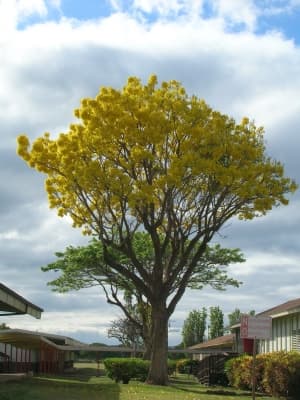
Roseodendron donnell-smithii
Roseodendron donnell-smithii
Safety & Hazards
None known
Cultivation Details
A plant of the humid tropics, where it is found at elevations from sea level to 1,000 metres[1]. It grows best in areas where annual daytime temperatures are within the range 22 - 28°c, but can tolerate 17 - 34°c[2]. It succeeds where the mean annual rainfall is in the range 1,000 - 3,000mm[1]. Requires a sunny position[1]. The tree is found on alluvial soils and soils derived from volcanic ash, metamorphic rock and limestone with pH from 5.5 to 7.5[1, 2]. Gold tree is fast growing[1]. Young trees coppice until they reach pole size[1]. A saw log rotation of 30 years has been suggested[1]. The plant flowers during the dry season when the tree is leafless and the display can last for almost 2 months[1]. Pods mature 4 months after flowering, the seeds are wind dispersed[1].
Propagation
Seed - sow in shaded beds or trays in loose, moist, well drained, fertile media[1]. The seeds should be lightly covered to protect against drying out[3]. Germination starts in 12 - 18 days and transplanting to nursery bags in 3 weeks. Seedlings attain plantable size in about 4 months[1]. Cite as: Tropical Plants Database, Ken Fern. tropical.theferns.info. 2026-02-20. <tropical.theferns.info/viewtropical.php?id=Roseodendron+donnell-smithii>
Pollinators
Data unavailable
References
- [1]World Agroforesty Centre — http://www.worldagroforestry.org/ ↩︎An excellent online database of a huge range of trees giving very good information on each plant - its uses, ecology, identity, propagation, pests etc.
- [2]Ecocrop — http://ecocrop.fao.org/ecocrop/srv/en/home ↩︎Basic information on a wide range of useful plants, plus details of environmental needs where available.
- [3]Plant Resources of Southeast Asia — http://proseanet.org/ ↩︎Lots of information on the uses of the plants of SE Asia.
- [4]The New RHS Dictionary of Gardening. 1992. — Huxley. A. · MacMillan Press · 1992 · ISBN 0-333-47494-5 ↩︎Excellent and very comprehensive, though it contains a number of silly mistakes. Readable yet also very detailed.
- [5]Tropical Timbers of the World. Ag. Handbook No. 607. — Chudnoff. Martin. · USDA Forest Service. Wisconsin. · 1984 ↩︎Terse details on the properties of the wood of almost 400 species of trees from the Tropics.
- [6]Flora of Guatemala — Standley P.C. & J. A. Steyermark · 1946 - 1976 · http://www.archive.org/ ↩︎A superb reference, though somewhat dated. Gives lots of plant uses as well as information on plant habit and habitat. The entire flora (13 volumes) can now be downloaded from http://www.archive.org/
- [7]IUCN Red List of Threatened Species — http://www.iucnredlist.org/ ↩︎A list of plants under threat and facing possible extinction, usually with brief details of the threats and information on habitat.
- [8]Dictionary of Economic Plants. — Uphof. J. C. Th. · Weinheim · 1959 · ISBN - ↩︎An excellent and very comprehensive guide but it only gives very short descriptions of the uses without any details of how to utilize the plants. Not for the casual reader.