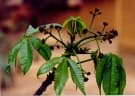
Ricinodendron heudelotii
Ricinodendron heudelotii
Safety & Hazards
None known
Cultivation Details
A plant mainly of the tropics, where it can also be found at elevations up to 2,000 metres. It grows best in areas where the mean minimum and maximum temperatures are within the range 20 - 30°c, but can tolerate 14 - 34°c[1]. It prefers a mean annual rainfall in the range 800 - 4,000mm, but tolerates 500 - 5,000mm[1]. Grows best in a sunny position[2, 3]. Prefers a medium textured, freely draining, acidic soil[4].Prefers a pH in the range 5.5 - 6.5, tolerating 5 - 7[1]. A very fast-growing tree, in open light spaces it will bear fruit in its seventh to tenth year of growth[3]. The tree responds well to coppicing and pollarding, regenerating readily from the stump[4, 3]. Some reports suggest the tree does not alwyas coppice well[2]. The tree grows spontaneously from seed and is often preserved in the neighbourhood of forest villages[3]. A dioecious species, both male and female forms need to be grown if fruit and seed are required.
Propagation
Seed - it has a hard seedcoat and may benefit from scarification before sowing in order to speed up and improve germination. This can usually be done by pouring a small amount of nearly boiling water on the seeds (being careful not to cook them!) and then soaking them for 12 - 24 hours in warm water. By this time they should have imbibed moisture and swollen - if they have not, then carefully make a nick in the seedcoat (being careful not to damage the embryo) and soak for a further 12 hours before sowing. Sow in a nursery seedbed in a fairly open position. Germination of treated seed commences about 3 - 6 weeks after sowing[2]. Fairly large cuttings root easily[2]. Cite as: Tropical Plants Database, Ken Fern. tropical.theferns.info. 2026-02-20. <tropical.theferns.info/viewtropical.php?id=Ricinodendron+heudelotii>
Pollinators
Data unavailable
References
- [1]Ecocrop — http://ecocrop.fao.org/ecocrop/srv/en/home ↩︎Basic information on a wide range of useful plants, plus details of environmental needs where available.
- [2]Protabase - Plant Resources of Tropical Africa. — http://www.prota.org ↩︎An excellent on-line database with detailed information on over 3,200 species of useful plants of Africa.
- [3]The Useful Plants of West Tropical Africa. — Burkil. H. M. · Royal Botanic Gardens; Kew. · 1985 - 2004 ↩︎Brief descriptions and details of the uses of over 4,000 plants. A superb, if terse, resource, it is also available electronically on the Web - see http://www.aluka.org/
- [4]World Agroforesty Centre — http://www.worldagroforestry.org/ ↩︎An excellent online database of a huge range of trees giving very good information on each plant - its uses, ecology, identity, propagation, pests etc.
- [5]Edible Wild Plants of Tanzania — Ruffo, C.K.: Birnie, A. & Tengnas, B. · Regional Land Management Unit; Nairobi. · 2002 · ISBN 9966-896-60-0 ↩︎A very well presented, simple guide to growing and utilizing wild food plants in Tanzania, with line drawings of each plant, a description, habitat and range, non-food as well as food uses, plus basic information on growing the plants.
- [6]Tropical Timbers of the World. Ag. Handbook No. 607. — Chudnoff. Martin. · USDA Forest Service. Wisconsin. · 1984 ↩︎Terse details on the properties of the wood of almost 400 species of trees from the Tropics.
- [7]Cornucopia II — Facciola. S. · Kampong Publications, California. · 1998 · ISBN 0-9628087-2-5 ↩︎The second edition of an excellent guide to the edible uses of plants, though it does not give any details of cultivation etc.
- [8]Tropix 7 — CIRAD · http://tropix.cirad.fr/en ↩︎An on-line guide to the timbers of 245 species of trees.