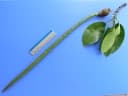
Rhizophora mucronata
Rhizophora mucronata
Safety & Hazards
None known
Cultivation Details
A plant of coastal areas of the moist to wet lowland tropics and subtropics[1]. It grows best in areas where annual daytime temperatures are within the range 20 - 28°c, but can tolerate 15 - 32°c[2]. It prefers a mean annual rainfall in the range 1,500 - 2,500mm, but tolerates 1,000 - 3,000mm[2]. Requires a sunny position[2]. A plant of saline and brackish soils that are inundated by salt water at high tides, it is also often found in deep, soft mud[3]. Plants can tolerate a pH in the range 6 - 8.5[3].Prefers a pH in the range 6.7 - 7.2, tolerating 6.5 - 7.5[2]. The tree grows slowly[3]. In Peninsular Malaysia it takes 35 - 40 years to reach up to 19 cm in diameter. A 40-years rotation is favourable[3]. There is a characteristic development of the seed in this genus. One seed is developed per fruit and starts to germinate when the fruit is still attached or hanging on the tree; this phenomenon is known as viviparous germination and is common among mangrove plants[4]. The root (radicle) gradually protrudes from the fruit, at first like a green cigar, then grows into a rod-like structure. In this species such a seedling root (hypocotyl) with a rough and warty surface may attain a considerable length (sometimes over 100 cm), the largest and longest in the genus[4]. Later the seedling falls out of the fruit, drops into the mud and sooner or later begins to grow[3]. The seedlings that have fallen into the water at high tide commonly drift to another place or are washed up on the shore; they retain their vitality for several months, and will survive and grow if the spot is ecologically suitable[4]. The main root of the seedling is usually abortive and lateral roots take over its function[4].
Propagation
Seed - young seedlings, gathered from the wild, can be used for planting[3]. Natural regeneration always occurs near mature trees[3]. There is a form of vegetative spread of the trees by horizontal growth of the lower branches supported by stilt roots; these branches can continue to grow if the parent trunk dies[3]. Cite as: Tropical Plants Database, Ken Fern. tropical.theferns.info. 2026-02-20. <tropical.theferns.info/viewtropical.php?id=Rhizophora+mucronata>
Pollinators
Wind, Self
References
- [1]Climbers and Wall Shrubs. — Davis. B. · Viking. · 1990 · ISBN 0-670-82929-3 ↩︎Contains information on 2,000 species and cultivars, giving details of cultivation requirements. The text is terse but informative.
- [2]Ecocrop — http://ecocrop.fao.org/ecocrop/srv/en/home ↩︎Basic information on a wide range of useful plants, plus details of environmental needs where available.
- [3]World Agroforesty Centre — http://www.worldagroforestry.org/ ↩︎An excellent online database of a huge range of trees giving very good information on each plant - its uses, ecology, identity, propagation, pests etc.
- [4]Plant Resources of Southeast Asia — http://proseanet.org/ ↩︎Lots of information on the uses of the plants of SE Asia.
- [5]The Useful Plants of the Island of Guam — Safford W.E. · Smithsonian Institute; Washington. · 1905 · http://www.biodiversitylibrary.org/ ↩︎A very comprehensive, if rather dated, guide to the plants of Guam. It can be downloaded from the Internet.
- [6]Dictionary of Economic Plants. — Uphof. J. C. Th. · Weinheim · 1959 · ISBN - ↩︎An excellent and very comprehensive guide but it only gives very short descriptions of the uses without any details of how to utilize the plants. Not for the casual reader.
- [7]Trees of Sungai Wain — http://www.nationaalherbarium.nl/Sungaiwain/ ↩︎An excellent site with factsheets on almost 1,000 species of forest trees growing at Sungai Wain in Indonesia. Each factsheet has good quality pictures plus basic information on the ecology and uses of the plants.
- [PFAF]Plants for a Future — pfaf.org ↩︎