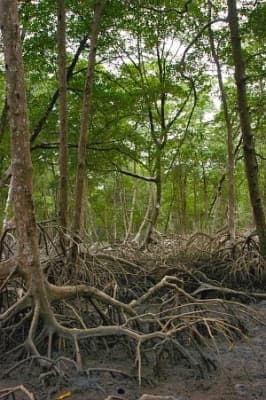
Rhizophora mangle
Rhizophora mangle
Safety & Hazards
None known
Cultivation Details
A tree of coastal areas in the tropics, moving into the subtropics. It grows best in areas where the mean annual rainfall is within the range 20 - 30°c, but can tolerate 10 - 38°c[1]. Plants can be killed if the temperature falls below zero[1]. The plant prefers a mean annual rainfall in the range 1,500 - 2,500mm, tolerating 1,000 - 3,000mm, and growing in areas with a distinct dry season, as well as one where rain can fall all year round[1]. Plants are found in areas with an annual rainfall of up to 10,000mm[2]. Grows best in a sunny position[1]. Succeeds in most soils, grows in areas that are subject to periodic inundation by sea water[3, 1]. Very tolerant of saline soils[1]. Prefers a pH in the range 6.7 - 7.2, tolerating 6.5 - 7.5[1]. The tree is capable of moderately fast growth of 1 - 1.5 metres per year on productive sites[2]. Young trees can begin flowering by 6 years of age, and possibly as young as 3 - 5 years[2]. Flowering has been reported in saplings as small as 0.5 - 1 metre[2]. Plants can flower all year round[4]. The method of propagation in nature is peculiar. While still attached to the tree, the seed develops a radicle about twice as thick as a lead pencil and 30 - 60cm long, which when detached falls like a dart and sticks upright in the mud, ready to put forth leaves and roots[5]. If the seeds are carried away by currents they float upright until they reach a lodging place[5].
Propagation
The seed germinates whilst still on the parent plant. The seedling, known as a propagule, takes 4 - 7 months from fertilization until the emergence of the hypocotyl[2]. Another 4 - 6 months typically elapse before the propagule falls from the parent tree, by which time it is between 8 - 30cm long[2]. Propagules can be collected directly from trees, from the ground, or from water surfaces. Propagules collected from trees should be fully developed and nearing abscission; these propagules usually detach from the pericarp with a gentle pull[2]. Collected propagules should be bright green (except the lower portion, which is normally brown), have no roots or damaged plumules, and be free of other visible damage and/or discoloration[2]. They can be stored in a moist container for at least 3 - 4 weeks before planting out into their permanent positions[2]. Cite as: Tropical Plants Database, Ken Fern. tropical.theferns.info. 2026-02-20. <tropical.theferns.info/viewtropical.php?id=Rhizophora+mangle>
Pollinators
Bees, Wind
References
- [1]Ecocrop — http://ecocrop.fao.org/ecocrop/srv/en/home ↩︎Basic information on a wide range of useful plants, plus details of environmental needs where available.
- [2]Tropical Tree Seed Manual — Vosso. J. Editor. · USDA Forest Service. · 2002 · http://www.rngr.net/Publications/ttsm ↩︎An extremely good guide, it can also be downloaded in its entirety from the address shown above.
- [3]Institute of Food and Agricultural Sciences, University of Florida — University of Florida · http://hort.ifas.ufl.edu/shrubs/ ↩︎PDF fact sheets on over 500 shrubs.
- [4]Manual of the Trees of N. America. — Sargent. C. S. · Dover Publications Inc. New York. · 1965 · http://www.biodiversitylibrary.org/ · ISBN 0-486-20278-X ↩︎Two volumes, a comprehensive listing of N. American trees though a bit out of date now. Good details on habitats, some details on plant uses. Not really for the casual reader. It can be downloaded from the internet.
- [5]Flora of Guatemala — Standley P.C. & J. A. Steyermark · 1946 - 1976 · http://www.archive.org/ ↩︎A superb reference, though somewhat dated. Gives lots of plant uses as well as information on plant habit and habitat. The entire flora (13 volumes) can now be downloaded from http://www.archive.org/
- [6]Tropical Timbers of the World. Ag. Handbook No. 607. — Chudnoff. Martin. · USDA Forest Service. Wisconsin. · 1984 ↩︎Terse details on the properties of the wood of almost 400 species of trees from the Tropics.
- [7]Cornucopia II — Facciola. S. · Kampong Publications, California. · 1998 · ISBN 0-9628087-2-5 ↩︎The second edition of an excellent guide to the edible uses of plants, though it does not give any details of cultivation etc.
- [8]Dictionary of Economic Plants. — Uphof. J. C. Th. · Weinheim · 1959 · ISBN - ↩︎An excellent and very comprehensive guide but it only gives very short descriptions of the uses without any details of how to utilize the plants. Not for the casual reader.
- [9]Medicinal Plants of the Guianas — DeFilipps, R. A.; Maina, S. L.; & Crepin, J. · Smithsonian Museum · http://botany.si.edu/bdg/medicinal/index.html ↩︎A down-loadable PDF document of a book in pre-publication awaiting illustration. An excellent, if rather terse, guide to the traditional medicinal uses of the plants of the region