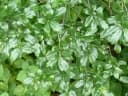
Rhamnus prinoides
Rhamnus prinoides
Safety & Hazards
Species in this genus contain hydroxyanthracene derivatives which have a stimulant laxative effect upon the body, and many species are used traditionally as laxatives. In small doses, and for short periods, these can be safe and effective, but used over long periods they can weaken the body's natural ability to defecate and can have a range of long-lasting negative effects upon the body, including anaemia, malabsorption, haematuria and weight loss. Large single doses can cause severe purging.
Cultivation Details
A plant of medium to high elevations in subtropical to tropical areas, where it is found at elevations up to 2,000 metres[1]. Found at elevations up to 3,700 metres[2]. The plant grows best in areas where the mean annual temperature falls within the range 14 - 22°c, but can tolerate 8 - 32°c[1]. Established plants can withstand a fair amount of frost, down to -5°c when in growth and as low as -15°c when dormant[1]. It prefers a mean annual rainfall in the range 600 - 800mm, tolerating 500 - 1,200mm and is usually found in areas with a distinct dry season[1]. Grows well in light shade under trees and equally well in full sun[1]. Succeeds in most soils, but thrives best in moist, humus-rich soils[1]. Prefers a pH in the range 5.5 - 6.5, but tolerates 5 - 7[1]. The tree responds well to coppicing[3]. Generally slow-growing when in low rainfall areas, though it can grow 1 metre per year in wetter areas[4]. The plant has a non-invasive root system[4].
Propagation
Seed - germinates readily when sown fresh[3]. Most of the seeds germinate, taking from 2 - 6 weeks, with some still germinating after 8 weeks. Germination rate is usually 80 - 90%[4]. Cite as: Tropical Plants Database, Ken Fern. tropical.theferns.info. 2026-02-20. <tropical.theferns.info/viewtropical.php?id=Rhamnus+prinoides>
Pollinators
Data unavailable
References
- [1]Ecocrop — http://ecocrop.fao.org/ecocrop/srv/en/home ↩︎Basic information on a wide range of useful plants, plus details of environmental needs where available.
- [2]African Flowering Plants Database — Conservatoire et Jardin Botaniques. · http://www.ville-ge.ch/musinfo/bd/cjb/africa/recherche.php ↩︎Contains information on over 150,000 plant names (including synonyms) giving a description and habitat, plus a distribution map.
- [3]Useful Trees and Shrubs in Eritrea — Bein. E.; Habte. B.; Jaber. A.; Birnie. A. & Tengnas. B. · Regional Soil Conservation Unit: Nairobi · 1996 · ISBN 9966-896-24-4 ↩︎A very well written and concise guide to almost 200 species. It gives a brief description of each plant together with its habitat, uses, propagation and cultivation. Line drawings of each plant are also included It can be downloaded from the internet
- [4]World Agroforesty Centre — http://www.worldagroforestry.org/ ↩︎An excellent online database of a huge range of trees giving very good information on each plant - its uses, ecology, identity, propagation, pests etc.
- [5]Report on the Natal Forests — Fourcade H.G. · Wm. ;, Natal · 1889 · http://www.biodiversitylibrary.org ↩︎Contains a list of the trees of Natal, with a brief listing of their uses, including many traditional uses. The report can be downloaded from the Internet.
- [6]Cornucopia II — Facciola. S. · Kampong Publications, California. · 1998 · ISBN 0-9628087-2-5 ↩︎The second edition of an excellent guide to the edible uses of plants, though it does not give any details of cultivation etc.
- [7]Flora of the USSR. — Komarov. V. L. · Israel Program for Scientific Translation · 1968 · http://www.biodiversitylibrary.org · ISBN - ↩︎An immense (25 or more large volumes) and not yet completed translation of the Russian flora. Full of information on plant uses and habitats but heavy going for casual readers. It can be downloaded from the Internet.