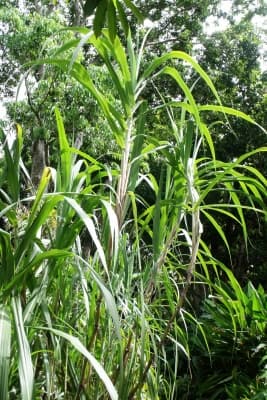
Saccharum edule
Saccharum edule
Safety & Hazards
None known
Botanical Description
Lowland pitpit is a vigorous, perennial grass forming large clumps that usually reach 1.5 - 4 metres in height[ 418 Title Ecocrop Publication Author Website http://ecocrop.fao.org/ecocrop/srv/en/home Publisher Year 0 ISBN Description Basic information on a wide range of useful plants, plus details of environmental needs where available. ]. The inflorescences are abnormal in the sense that they remain enclosed within the leaf-sheaths, forming a compact mass about the size of a banana.[ 418 Title Ecocrop Publication Author Website http://ecocrop.fao.org/ecocrop/srv/en/home Publisher Year 0 ISBN Description Basic information on a wide range of useful plants, plus details of environmental needs where available. ] The plant is cultivated in tropical Asia for the edible flowering stems. These are often sold in local markets and are sometimes canned as a commercial crop[ 339 Title Agroforestry in the Pacific Islands: Systems for Sustainability Publication Author W.C. Clarke and R.R. Thaman (Editors) Website http://www.unu.edu/unupress/unupbooks/80824e/80824E00.htm#Contents Publisher United Nations University Press, Tokyo Year 1993 ISBN 92-808-0824-9 Description The guide includes information on 100 species of plants for Agroforestry. It is also available on the web at the address given above. ].