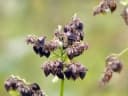
Fagopyrum esculentum
Fagopyrum esculentum
Safety & Hazards
Buckwheat seed is considered to be one of the most important food allergens. It also contains compounds which can cause irritating skin disorders (‘fagopyrism’) mainly in sheep and pigs and occasionally in humans, especially in cases where there is heavy consumption and also exposure to sunlight[ 299 Title Protabase - Plant Resources of Tropical Africa. Publication Author Website http://www.prota.org Publisher Year 0 ISBN Description An excellent on-line database with detailed information on over 3,200 species of useful plants of Africa. ]. Fagopyrism has also been observed in humans after consumption of buckwheat honey. It may also affect cattle when fed pure buckwheat silage[ 299 Title Protabase - Plant Resources of Tropical Africa. Publication Author Website http://www.prota.org Publisher Year 0 ISBN Description An excellent on-line database with detailed information on over 3,200 species of useful plants of Africa. ]. The plant has caused photosensitivity in some people, only the dehusked grain is considered to be safe.
Botanical Description
Fagopyrum esculentum is an erect, much-branched annual plant with hollow stems; it can grow from 60 - 120cm tall[ 299 Title Protabase - Plant Resources of Tropical Africa. Publication Author Website http://www.prota.org Publisher Year 0 ISBN Description An excellent on-line database with detailed information on over 3,200 species of useful plants of Africa. ]. The seed of buckwheat is an important subsistence food in parts of Asia, where the plant has a history of cultivation going back at least 1,000 years. The seed has gained acceptance as a healh food, whilst the plant also has edible leaves, some important traditional medicinal actions and supplies a dye. It is often grown on a garden scale, and also commercially on a small scale, for its edible leaves and seeds, whilst it is also commonly grown as a green manure crop and to restore worn-out soils. Fagopyrum esculentum is cultivated in many parts of the world for its edible seed. It is a prolific producer of seed and these are often spread by animal activity. It easily escapes from cultivation and can become established as a weed of cultivated and waste ground, though it is easy to control and does not usually become a pest.