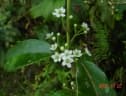
Ilex mitis
Ilex mitis
Safety & Hazards
Although no specific reports of toxicity have been seen for this species, Ilex species in general contain several potentially toxic compounds, particularly saponins, glycosides and triterpenoids. These compounds also often have a range of potential health benefits[ 274 Title Illustrated Flora of North Central Texas Publication Author Diggs, Jnr. G.M.; Lipscomb. B. L. & O'Kennon. R. J Website http://artemis.austincollege.edu/acad/bio/gdiggs/NCTXpdf.htm Publisher Botanical Research Institute, Texas. Year 1999 ISBN 1-889878-01-4 Description An excellent flora, which is also available on-line. , 293 Title Poisonous Plants of North Carolina Publication Author Website http://www.ces.ncsu.edu/depts/hort/consumer/poison/poison.htm Publisher Year 0 ISBN Description An excellent concise but comprehensive guide to toxic plants that grow in N. Carolina. It lists even those plants that are of very low toxicity, including several well-known food plants such as carrots and potatoes. , 2070 Title Genus Ilex L.: Phytochemistry, Ethnopharmacology, and Pharmacology Publication Chinese Herbal Medicines, 2016 , 8(3): 209-230 Author Fan Yi, Xiao-ling Zhao, Yong Peng, Pei-gen Xiao Website http://10.1016/S1674-6384(16)60044-8 Publisher Year 2016 ISBN Description ]. The berries are usually the part of the plant most likely to be toxic, though the degree of toxicity is usually low. Their bitter flavour usually prevents a person eating more than one or two, but even a small handful of the fruit eaten by a healthy adult is unlikely to cause more than feelings of nausea that can lead on to vomiting and diarrhoea[ 293 Title Poisonous Plants of North Carolina Publication Author Website http://www.ces.ncsu.edu/depts/hort/consumer/poison/poison.htm Publisher Year 0 ISBN Description An excellent concise but comprehensive guide to toxic plants that grow in N. Carolina. It lists even those plants that are of very low toxicity, including several well-known food plants such as carrots and potatoes. ]. The compounds in the leaves are particularly interesting. The leaves of many Ilex species around the world are commonly used to make health-promoting teas that, when drunk on a regular basis, help to regulate bodily functions and can reduce the risk of heart disease, lower blood-cholesterol levels etc (See Ilex paraguariensis or Ilex kaushue for examples)[ 2070 Title Genus Ilex L.: Phytochemistry, Ethnopharmacology, and Pharmacology Publication Chinese Herbal Medicines, 2016 , 8(3): 209-230 Author Fan Yi, Xiao-ling Zhao, Yong Peng, Pei-gen Xiao Website http://10.1016/S1674-6384(16)60044-8 Publisher Year 2016 ISBN Description ]. Even these teas, however, if taken in very concentrated doses, can act as a laxative or cause vomiting. Indeed, several species are used by traditional peoples to induce vomiting as a means of purifying the body (see Ilex guayusa or Ilex vomitoria for examples)
Botanical Description
Ilex mitis is an evergreen tree with a straight, rounded canopy; it can range in size from 10 - 40 metres tall, though it is most likely to be 25 metres or less. The straight bole can be quite short, and can be up to 60cm in diameter[ 295 Title PlantZAfrica.com Publication Author Website http://www.plantzafrica.com Publisher Year 0 ISBN Description An excellent site giving detailed descriptions and uses of many S. African plants. , 303 Title World Agroforesty Centre Publication Author Website http://www.worldagroforestry.org/ Publisher Year 0 ISBN Description An excellent online database of a huge range of trees giving very good information on each plant - its uses, ecology, identity, propagation, pests etc. , 364 Title Field Guide to the Moist Forest Trees of Tanzania. Publication Author Lovett J.C.; Ruffo C.K.; Gereau R.E.; Taplin J.R.D Website http://www.york.ac.uk/res/celp/webpages/projects/ecology/tree%20guide/introduction.htm Publisher Frontier Year 0 ISBN 1-873070-33-0 Description A lovely little book giving a basic identification guide to more than 650 species of trees growing in Tanzania. It is also available to view on the internet. ]. The plant is sometimes harvested from the wild for food and medicinal purposes, and for its high quality wood which is used locally. The bark is used commercially to make creams and lotions that are sold as skin care products[ 338 Title IUCN Red List of Threatened Species Publication Author Website http://www.iucnredlist.org/ Publisher Year 0 ISBN Description A list of plants under threat and facing possible extinction, usually with brief details of the threats and information on habitat. ]. The bright red fruits and glossy leaves make this tree a great candidate for ornamental purposes[ 303 Title World Agroforesty Centre Publication Author Website http://www.worldagroforestry.org/ Publisher Year 0 ISBN Description An excellent online database of a huge range of trees giving very good information on each plant - its uses, ecology, identity, propagation, pests etc. ]. Ilex mitis has a very wide range and, although the population is in decline in some areas due to anthropegenic activity, the species regenerates well and is generally common across its range. The plant is classified as 'Least Concern' in the IUCN Red List of Threatened Species(2018)[ 338 Title IUCN Red List of Threatened Species Publication Author Website http://www.iucnredlist.org/ Publisher Year 0 ISBN Description A list of plants under threat and facing possible extinction, usually with brief details of the threats and information on habitat. ].