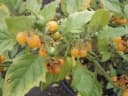
Solanum villosum
Solanum villosum
Safety & Hazards
Although providing many well-known foods for people, including the potato, tomato, pepper and aubergine, most species in this genus also contain toxic alkaloids. Whilst these alkaloids can make the plant useful in treaing a range of medical conditions, they can also cause problems such as nausea, vomiting, salivation, drowsiness, abdominal pain, diarrhoea, weakness and respiratory depression[ 293 Title Poisonous Plants of North Carolina Publication Author Website http://www.ces.ncsu.edu/depts/hort/consumer/poison/poison.htm Publisher Year 0 ISBN Description An excellent concise but comprehensive guide to toxic plants that grow in N. Carolina. It lists even those plants that are of very low toxicity, including several well-known food plants such as carrots and potatoes. ]. Unless there are specific entries with information on edible uses, it would be unwise to ingest any part of this plant[ K Title Plants for a Future Author Ken Fern Description Notes from observations, tasting etc at Plants For A Future and on field trips. ].
Botanical Description
Solanum villosum is an unarmed, much-branched annual or short-lived perennial herb; it can grow 50cm tall, occasionally to 60cm[ 299 Title Protabase - Plant Resources of Tropical Africa. Publication Author Website http://www.prota.org Publisher Year 0 ISBN Description An excellent on-line database with detailed information on over 3,200 species of useful plants of Africa. ]. The plant is harvested from the wild for local use as a food and medicine. The leaves are often sold as a food in local markets in Africa, where the plant is also sometimes cultivated[ 299 Title Protabase - Plant Resources of Tropical Africa. Publication Author Website http://www.prota.org Publisher Year 0 ISBN Description An excellent on-line database with detailed information on over 3,200 species of useful plants of Africa. ]. Solanum villosum probably originated in southern Europe but is now widespread as a weed throughout central and southern Europe, the Middle East and Asia. It is also common in northern and tropical Africa whence it might have been introduced as it was to North America, New Zealand and Australia (where it is occasionally naturalised) and probably also to the UK and northern Europe[ 610 Title Flora of Tropical East Africa Publication Author Beentje H.J. Website http://plants.jstor.org/search?st=396814 Publisher Royal Botanic Gardens; Kew. Year 2002 ISBN Description Available on-line, a modern flora of East Africa. ].