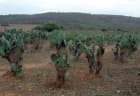
Opuntia cochenillifera
Opuntia cochenillifera
Safety & Hazards
The plant has numerous minutely barbed glochids - these are barbed spines that are usually small to minute and are very sharp and brittle. The glochids are very easily dislodged when the plant is touched and can penetrate the skin where, because of their barbs, they become stuck and are very difficult to see and remove. They can cause considerable irritation and discomfort[ 200 Title The New RHS Dictionary of Gardening. 1992. Publication Author Huxley. A. Publisher MacMillan Press Year 1992 ISBN 0-333-47494-5 Description Excellent and very comprehensive, though it contains a number of silly mistakes. Readable yet also very detailed. , 1999 Title A natural history of the Sonoran Desert Publication Author Phillips S.J. & Comus P.W. Publisher University of California Press; Los Angeles, California Year 2000 ISBN 0-520-22029-3 Description ]. Opuntia species can contain quite high levels of oxalic acid, especially in older parts of the plant. Perfectly alright in small quantities, foods containing oxalic acid should not be eaten in large amounts since it can lock-up other nutrients in the food, especially calcium, thus causing mineral deficiencies. The oxalic acid content will be reduced if the plant is cooked. People with a tendency to rheumatism, arthritis, gout, kidney stones or hyperacidity should take especial caution if including this plant in their diet since it can aggravate their condition[ 238 Title Encyclopaedia of Herbs and their Uses. Publication Author Bown. D. Publisher Dorling Kindersley, London. Year 1995 ISBN 0-7513-020-31 Description A very well presented and informative book on herbs from around the globe. Plenty in it for both the casual reader and the serious student. Just one main quibble is the silly way of having two separate entries for each plant. , 1999 Title A natural history of the Sonoran Desert Publication Author Phillips S.J. & Comus P.W. Publisher University of California Press; Los Angeles, California Year 2000 ISBN 0-520-22029-3 Description ].
Botanical Description
Opuntia cochenillifera is a succulent, evergreen shrubby or tree-like cactus growing 4 - 5 metres tall with a bole that can be 20cm in diameter. The stems are mainly spineless, probably the result of selective breeding to make the plants easier to harvest. The plant is harvested from the wild for local use as a food, medicine and source of materials. In the past, the plant was often grown as a host plant for the cochineal insects (Dactylopius coccus) - these insects were then harvested, killed and made into the red dye cochineal. Synthetic dyes have almost totally usurped this use, though the plant is still often cultivated, but only as an ornamental and hedge plant[ 317 Title Mansfeld's Database of Agricultural and Horticultural Plants Publication Author Website http://mansfeld.ipk-gatersleben.de/pls/htmldb_pgrc/f?p=185:3:4292127278597336 Publisher Year 0 ISBN Description Terse details of a huge range of useful plants. ]. Opuntia cochenillifera is an extremely widespread and abundant species as a result of introductions and cultivation. However, the original range and hence the wild population of this species is unknown and therefore, its wild status cannot be assessed. Therefore the plant is classified as 'Data Deficient' in the IUCN Red List of Threatened Species(2017)[ 338 Title IUCN Red List of Threatened Species Publication Author Website http://www.iucnredlist.org/ Publisher Year 0 ISBN Description A list of plants under threat and facing possible extinction, usually with brief details of the threats and information on habitat. ].