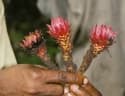
Thonningia sanguinea
Thonningia sanguinea
Safety & Hazards
The flowers are incorporated into arrow poisons[ 332 Title The Useful Plants of West Tropical Africa. Publication Author Burkil. H. M. Publisher Royal Botanic Gardens; Kew. Year 1985 - 2004 ISBN Description Brief descriptions and details of the uses of over 4,000 plants. A superb, if terse, resource, it is also available electronically on the Web - see http://www.aluka.org/ ]. This report does not make it clear if the flowers are believed to be poisonous, or whether they are used to enhance the action of the toxin[ K Title Plants for a Future Author Ken Fern Description Notes from observations, tasting etc at Plants For A Future and on field trips. ].
Botanical Description
Thonningia sanguinea is an obligate parasite of trees and perennial woody plants, unable to produce chlorophyll and totally dependant upon the host for its nutrients. Generally, the plant produces a stout long rhizome, tuberous at the point of attachment to the host’s roots. Only the scaly flower-heads appear above ground , growing up to 7cm tall[ 332 Title The Useful Plants of West Tropical Africa. Publication Author Burkil. H. M. Publisher Royal Botanic Gardens; Kew. Year 1985 - 2004 ISBN Description Brief descriptions and details of the uses of over 4,000 plants. A superb, if terse, resource, it is also available electronically on the Web - see http://www.aluka.org/ ]. The rhizomes are often gathered from the wild for local use as a flavouring and medicine. They are a common article of market trade in N Nigerian markets[ 332 Title The Useful Plants of West Tropical Africa. Publication Author Burkil. H. M. Publisher Royal Botanic Gardens; Kew. Year 1985 - 2004 ISBN Description Brief descriptions and details of the uses of over 4,000 plants. A superb, if terse, resource, it is also available electronically on the Web - see http://www.aluka.org/ ].