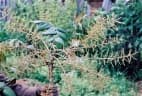
Polyscias fulva
Polyscias fulva
Safety & Hazards
None known
Botanical Description
Polyscias fulva is a deciduous to evergreen tree with a narrow, umbrella-shaped crown; it can grow 25 - 30 metres tall. The straight, cylindrical bole is unbranched for most of its height, up to 100cm in diameter and free of buttresses[ 299 Title Protabase - Plant Resources of Tropical Africa. Publication Author Website http://www.prota.org Publisher Year 0 ISBN Description An excellent on-line database with detailed information on over 3,200 species of useful plants of Africa. , 303 Title World Agroforesty Centre Publication Author Website http://www.worldagroforestry.org/ Publisher Year 0 ISBN Description An excellent online database of a huge range of trees giving very good information on each plant - its uses, ecology, identity, propagation, pests etc. , 418 Title Ecocrop Publication Author Website http://ecocrop.fao.org/ecocrop/srv/en/home Publisher Year 0 ISBN Description Basic information on a wide range of useful plants, plus details of environmental needs where available. ]. The tree is commonly harvested from the wild for mainly local use - the wood is particularly valued for carving, handicrafts and making drums, whilst the tree also has traditional medicinal uses. It is also used as a pioneer in reforestation projects and is grown as an ornamental[ 299 Title Protabase - Plant Resources of Tropical Africa. Publication Author Website http://www.prota.org Publisher Year 0 ISBN Description An excellent on-line database with detailed information on over 3,200 species of useful plants of Africa. , 418 Title Ecocrop Publication Author Website http://ecocrop.fao.org/ecocrop/srv/en/home Publisher Year 0 ISBN Description Basic information on a wide range of useful plants, plus details of environmental needs where available. ]. Polyscias fulva has a very wide distribution area, but it is uncommon in several regions, such as West Africa. In Kenya it has been reported as becoming rare in its natural habitat. This is also locally the case in Cameroon and Uganda, where the species has been overexploited for the production of handicrafts. Monitoring of populations in such regions where it is under pressure because of timber harvesting is recommended, but generally the tree is not yet subject to serious genetic erosion[ 299 Title Protabase - Plant Resources of Tropical Africa. Publication Author Website http://www.prota.org Publisher Year 0 ISBN Description An excellent on-line database with detailed information on over 3,200 species of useful plants of Africa. ].