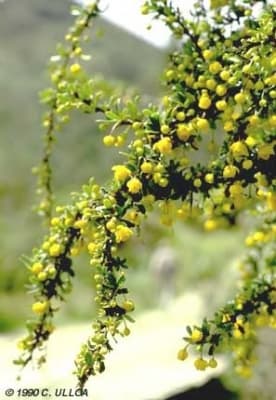
Berberis lutea
Berberis lutea
Safety & Hazards
All parts of the plant contain the alkaloid berberine - this is most concentrated in the roots, stems and inner bark, and least concentrated in the fruits. In small quantities berberine has a range of effective medicinal applications but, in excess, can cause vomiting, lowered blood pressure, reduced heart rate, lethargy, and other ill-effects. The fruit of most, if not all, members of this genus are more or less edible and can be eaten in quantity since the levels of berberine in the fruit are very low.
Botanical Description
Berberis lutea is an unarmed, evergreen shrub growing up to 3 metres tall. The wood is sometimes harvested from the wild for local use for tool handles and as a dye[ 46 Title Dictionary of Economic Plants. Publication Author Uphof. J. C. Th. Publisher Weinheim Year 1959 ISBN - Description An excellent and very comprehensive guide but it only gives very short descriptions of the uses without any details of how to utilize the plants. Not for the casual reader. , 630 Title Botanical Museum Leaflets Vol 28 Publication Author Website http://www.biodiversitylibrary.org Publisher Harvard University; Cambridge, Mass. Year 1981 ISBN Description An article on the Ethnopharmacological uses of plants in northwestern S. America, amongst many other articles. It can be downloaded from the Internet. ].