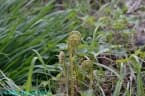
Pteridium aquilinum
Pteridium aquilinum
Safety & Hazards
There are a number of reports regarding the possible health risks of this plant. The huge quantity of spores released by large areas of bracken are suggested to be implicated in stomach cancers. A recent study suggests that this is not such a problem in Britain as was once believed, the spores are not produced in such high quantities nor do they travel so far due to our normally humid atmosphere. The leaves and roots contain substances that deprive the body of vitamin B1 if they are eaten raw, though they are possibly alright cooked[ 102 Title Native Harvests. Publication Author Kavasch. B. Publisher Vintage Books Year 1979 ISBN 0-394-72811-4 Description Another guide to the wild foods of America. ]. The leaves are also said to be carcinogenic[ 65 Title A Colour Atlas of Poisonous Plants. Publication Author Frohne. D. and Pfänder. J. Publisher Wolfe Year 1984 ISBN 0723408394 Description Brilliant. Goes into technical details but in a very readable way. The best work on the subject that I've come across so far. , 76 Title Poisonous Plants in Britain and their Effects on Animals and Man. Publication Author Cooper. M. and Johnson. A. Publisher HMSO Year 1984 ISBN 0112425291 Description Concentrates mainly on the effects of poisonous plants to livestock. ].
Botanical Description
Pteridium aquilinum is a perennial, herbaceous fern that can gow around 120 - 250cm tall. A very vigorous plant, able to spread widely due to its running rhizomatous rootstock - it can form large colonies. A true multipurpose plant with a wide range of applications, it is harvested from the wild for local use as a food, medicine and source of materials. The plant is cultivated on a small scale in Korea and the young shoots (fiddleheads) are commonly sold in local food markets[ 1665 Title Wild Food Plants in South Korea; Market Presence, New Crops, and Exports to the United States Publication Economic Botany, Vol. 50, No. 1 (Jan. - Mar., 1996), pp. 57-70 Author Pemberton R.W. & Nam Sook Lee Website http://www.jstor.org/stable/4255805 Publisher Year 1996 ISBN Description ]. This is an extremely invasive plant and is often a declared noxious weed. It is one of the most widespread plants in the world, being found in all parts of the globe other than the extreme north and south[ 4 Title A Modern Herbal. Publication Author Grieve. Publisher Penguin Year 1984 ISBN 0-14-046-440-9 Description Not so modern (1930's?) but lots of information, mainly temperate plants. ]. Plants can be cut down twice a year to provide compost material, this will not kill the plants. If the plants are cut down three times a year this will gradually weaken and eventually kill them.