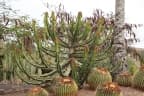
Euphorbia cooperi
Euphorbia cooperi
Safety & Hazards
The latex is said to be one of the most poisonous of the Euphorbia spp., causing intense skin irritations and producing a burning sensation in the throat when standing next to bleeding plants. The latex may cause blindness if it comes into the eyes. It has a pungent, acrid smell[ 299 Title Protabase - Plant Resources of Tropical Africa. Publication Author Website http://www.prota.org Publisher Year 0 ISBN Description An excellent on-line database with detailed information on over 3,200 species of useful plants of Africa. ]. The flowers produce much nectar, but the honey, known as ‘noors honey’, causes a burning sensation in the mouth, which is intensified by drinking water[ 299 Title Protabase - Plant Resources of Tropical Africa. Publication Author Website http://www.prota.org Publisher Year 0 ISBN Description An excellent on-line database with detailed information on over 3,200 species of useful plants of Africa. ]. The latex is used as a fish poison[ 299 Title Protabase - Plant Resources of Tropical Africa. Publication Author Website http://www.prota.org Publisher Year 0 ISBN Description An excellent on-line database with detailed information on over 3,200 species of useful plants of Africa. ].
Botanical Description
Euphorbia cooperi is a spiny, succulent, evergreen shrub growing up to 2 metres tall, or more commonly it becomes a candelabriform small tree up to 6 metres or occasionally even to 12 metres tall with branches curved upwards, simple or sometimes branched near the apex, forming a flat-topped crown. The bole is stout and cylindrical, unbranched for up to 3 metres and scarred from fallen branches; the branches are 5 - 20cm in diameter, deeply constricted at irregular intervals into oblong segments 10 - 50cm long. There is an abundant latex in all parts of the plant[ 295 Title PlantZAfrica.com Publication Author Website http://www.plantzafrica.com Publisher Year 0 ISBN Description An excellent site giving detailed descriptions and uses of many S. African plants. , 299 Title Protabase - Plant Resources of Tropical Africa. Publication Author Website http://www.prota.org Publisher Year 0 ISBN Description An excellent on-line database with detailed information on over 3,200 species of useful plants of Africa. , 328 Title African Flowering Plants Database Publication Author Website http://www.ville-ge.ch/musinfo/bd/cjb/africa/recherche.php Publisher Conservatoire et Jardin Botaniques. Year 0 ISBN Description Contains information on over 150,000 plant names (including synonyms) giving a description and habitat, plus a distribution map. ]. The leafless stems are cactus-like[ 423 Title Desert Tropicals Publication Author Website http://www.desert-tropicals.com/ Publisher Year 0 ISBN Description The main focus of the site is succulent plants, but it also contains information on a wide range of other species. Usually at least one good photograph, plus basic information about the plant and its cultivation. ]. The plant is harvested from the wild for local use as a medicine and for fencing. It is planted as an ornamental in succulent gardens or rock gardens in South Africa and the United States[ 299 Title Protabase - Plant Resources of Tropical Africa. Publication Author Website http://www.prota.org Publisher Year 0 ISBN Description An excellent on-line database with detailed information on over 3,200 species of useful plants of Africa. ].