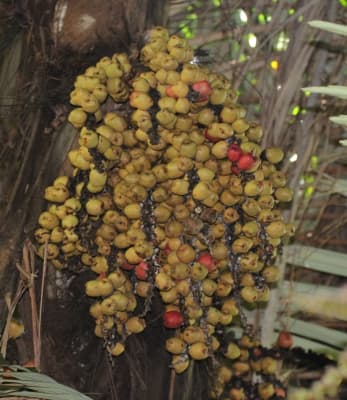
Arenga obtusifolia
Arenga obtusifolia
Safety & Hazards
The fruits of most species in this genus are poisonous and are sometimes used criminally[ 310 Title Plant Resources of Southeast Asia Publication Author Website http://proseanet.org/ Publisher Year 0 ISBN Description Lots of information on the uses of the plants of SE Asia. ]. The fleshy mesocarp of the fruits usually contains many oxalate crystals, making the flesh inedible[ 310 Title Plant Resources of Southeast Asia Publication Author Website http://proseanet.org/ Publisher Year 0 ISBN Description Lots of information on the uses of the plants of SE Asia. ].
Botanical Description
Arenga obtusifolia is an evergreen, cluster-forming palm that can grow up to 20 metres tall. The unbranched stems can be 15 - 30cm in diameter, crowned with a rosette of around 8 large leaves[ 310 Title Plant Resources of Southeast Asia Publication Author Website http://proseanet.org/ Publisher Year 0 ISBN Description Lots of information on the uses of the plants of SE Asia. , 314 Title Palm and Cycad Societies of Australia. Publication Author Website http://www.pacsoa.org.au/ Publisher Year 0 ISBN Description Contains at least a little information on the majority of palm and cycad species, plus a wealth of photographs. A first class website. ]. The plant produces new stems from a stoloniferous growth that can be up to 15 metres long[ 310 Title Plant Resources of Southeast Asia Publication Author Website http://proseanet.org/ Publisher Year 0 ISBN Description Lots of information on the uses of the plants of SE Asia. ]. The plant is harvested from the wild for local use as a food and source of materials. All species in this genus have either recognized or potential ornamental value[ 310 Title Plant Resources of Southeast Asia Publication Author Website http://proseanet.org/ Publisher Year 0 ISBN Description Lots of information on the uses of the plants of SE Asia. ].