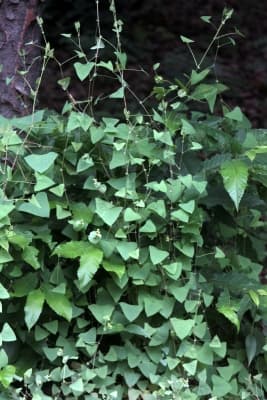
Persicaria perfoliata
Persicaria perfoliata
Safety & Hazards
Although no specific mention has been made for this species, there have been reports that some members of this genus can cause photosensitivity in susceptible people. Many species also contain oxalic acid (the distinctive lemony flavour of sorrel) - whilst not toxic this substance can bind up other minerals making them unavailable to the body and leading to mineral deficiency. Having said that, a number of common foods such as sorrel and rhubarb contain oxalic acid and the leaves of most members of this genus are nutritious and beneficial to eat in moderate quantities. Cooking the leaves will reduce their content of oxalic acid. People with a tendency to rheumatism, arthritis, gout, kidney stones or hyperacidity should take especial caution if including this plant in their diet since it can aggravate their condition[ 238 Title Encyclopaedia of Herbs and their Uses. Publication Author Bown. D. Publisher Dorling Kindersley, London. Year 1995 ISBN 0-7513-020-31 Description A very well presented and informative book on herbs from around the globe. Plenty in it for both the casual reader and the serious student. Just one main quibble is the silly way of having two separate entries for each plant. ].
Botanical Description
Persicaria perfoliata is an annual to perennial plant with trailing stems growing 80 - 200cm long, sometimes to 700cm or more[ 266 Title Flora of China Publication Author Website http://flora.huh.harvard.edu/china/ Publisher Missouri Botanical Garden Press; St. Louis. Year 1994 ISBN Description An excellent, comprehensive resource in 25 volumes. In addition to the botanical information the flora also gives basic information on habitat and some uses. An on-line version is also available. , 270 Title Flora of N. America Publication Author Website http://flora.huh.harvard.edu/fna/ Publisher Year 0 ISBN Description An on-line version of the flora with an excellent description of the plant including a brief mention of plant uses. ]. The stems have recurved barbs, which allow it to clamber over other plants to reach the light[ 413 Title Global Invasive Species Database Publication Author Website http://www.issg.org/database/welcome/ Publisher Year 0 ISBN Description Very detailed information on almost 400 species (with more being added) of plants that have become weeds in areas outside their native range. ]. The plant is sometimes gathered from the wild for local use as a food and medicine. It has been cultivated as a leaf vegetable in south Benin[ 317 Title Mansfeld's Database of Agricultural and Horticultural Plants Publication Author Website http://mansfeld.ipk-gatersleben.de/pls/htmldb_pgrc/f?p=185:3:4292127278597336 Publisher Year 0 ISBN Description Terse details of a huge range of useful plants. ] and has sometimes been grown as an ornamental. Persicaria perfoliata is a fast growing, spiny, herbaceous vine. Like many other members of the genus, it can be an aggressive and/or invasive weed. It has invaded a wide range of habitats in the USA, being found on stream banks, moist thickets, roadsides, nurseries, wood-piles, clearings and ditches, thriving where forests are clear-cut. The plant scrambles over shrubs and other vegetation, and blocks their foliage from available light, thus reducing their ability to photosynthesize. If left unchecked, the shaded plants are killed, and large infestations eventually reduce native plant species in natural areas. In addition, the leaves, petioles, and stems of Persicaria perfoliata contain prickles, causing the movement of wildlife, and human activities to be impacted in infested areas. In its native China the plant has rarely been recorded as an important noxious weed in either agriculture or the environment[ 413 Title Global Invasive Species Database Publication Author Website http://www.issg.org/database/welcome/ Publisher Year 0 ISBN Description Very detailed information on almost 400 species (with more being added) of plants that have become weeds in areas outside their native range. , 1093 Title Invasive Species Compendium Publication Author Website http://www.cabi.org Publisher Year 0 ISBN Description An immense resource - in depth information on over 900 species of invasive plants (it also has information on animals, fungi etc). ]. The plant is a threat to ecosystems as it has the ability to outgrow the native species[ 413 Title Global Invasive Species Database Publication Author Website http://www.issg.org/database/welcome/ Publisher Year 0 ISBN Description Very detailed information on almost 400 species (with more being added) of plants that have become weeds in areas outside their native range. ].