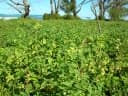
Physalis angulata
Physalis angulata
Safety & Hazards
The unripe fruits and foliage of Physalis species contain solanine and other solanidine alkaloids and are toxic if ingested in large quantities. The ripe fruiys are usually edible, and several species are cultivated for these fruits[ 270 Title Flora of N. America Publication Author Website http://flora.huh.harvard.edu/fna/ Publisher Year 0 ISBN Description An on-line version of the flora with an excellent description of the plant including a brief mention of plant uses. ].
Botanical Description
Physalis angulata is an erect, annual plant with spreading branches; growing from a taproot it can grow 10 - 200cm tall. The lower stems are sometimes prostrate and root at the nodes[ 270 Title Flora of N. America Publication Author Website http://flora.huh.harvard.edu/fna/ Publisher Year 0 ISBN Description An on-line version of the flora with an excellent description of the plant including a brief mention of plant uses. , 310 Title Plant Resources of Southeast Asia Publication Author Website http://proseanet.org/ Publisher Year 0 ISBN Description Lots of information on the uses of the plants of SE Asia. ]. The plant is harvested from the wild for local use as a food and is used in the traditional treatment of a wide variety of diseases[ 1093 Title Invasive Species Compendium Publication Author Website http://www.cabi.org Publisher Year 0 ISBN Description An immense resource - in depth information on over 900 species of invasive plants (it also has information on animals, fungi etc). ]. It is often allowed to remain when it appears as a weed of cultivation and is also sometimes cultivated at a local level for its edible fruit, which is commonly sold in local markets in Mexico[ 50 Title Flora Europaea Publication Author ? Publisher Cambridge University Press Year 1964 ISBN - Description An immense work in 6 volumes (including the index). The standard reference flora for Europe, it is very terse though and with very little extra information. Not for the casual reader. , 299 Title Protabase - Plant Resources of Tropical Africa. Publication Author Website http://www.prota.org Publisher Year 0 ISBN Description An excellent on-line database with detailed information on over 3,200 species of useful plants of Africa. , 338 Title IUCN Red List of Threatened Species Publication Author Website http://www.iucnredlist.org/ Publisher Year 0 ISBN Description A list of plants under threat and facing possible extinction, usually with brief details of the threats and information on habitat. , 2214 Title Taxonomic revision of Physalis in Mexico Publication Front. Genet. 14:1080176 Author Martínez M. et al Website http:// 10.3389/fgene.2023.1080176 Publisher Year 2023 ISBN Description ]. Physalis angulata has a very wide distribution range from the United States of America, throughout Mexico, Central and South Amercia. It occurs in a wide range of habitats and a number of protected areas. The plant is classified as 'Least Concern' in the IUCN Red List of Threatened Species(2017)[ 338 Title IUCN Red List of Threatened Species Publication Author Website http://www.iucnredlist.org/ Publisher Year 0 ISBN Description A list of plants under threat and facing possible extinction, usually with brief details of the threats and information on habitat. ]. Physalis angulata is an annual species of American origin which has been very widely introduced across many tropical, subtropical and warmer temperate regions. It is often characterized as a pantropical invasive weed of crops, gardens and plantations, although in many regions it has naturalized (such as Central America, Africa, India and Pacific islands) It is a host of many diseases of commercial crops, including the causal agent of tomato bacterial spot, as well as viruses found in tobacco, potato, okra, capsicum pepper, lucerne, beans and several other crops, physalis mottle virus, and also several root-knot nematodes[ 1093 Title Invasive Species Compendium Publication Author Website http://www.cabi.org Publisher Year 0 ISBN Description An immense resource - in depth information on over 900 species of invasive plants (it also has information on animals, fungi etc). ].