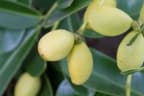
Simarouba amara
Simarouba amara
Safety & Hazards
The residual cake left after processing the crude fat from the seed contains a toxin[ 418 Title Ecocrop Publication Author Website http://ecocrop.fao.org/ecocrop/srv/en/home Publisher Year 0 ISBN Description Basic information on a wide range of useful plants, plus details of environmental needs where available. ].
Botanical Description
Simarouba amara is a large, evergreen tree with a broad crown that can reach a height of 42 metres tall, though is usually smaller. The straight, cylindrical, unbuttressed bole is up to 50 - 60cm in diameter, strongly tapered and frequently unbranched for 20 - 27 metres[ 316 Title Tropical Timbers of the World. Ag. Handbook No. 607. Publication Author Chudnoff. Martin. Publisher USDA Forest Service. Wisconsin. Year 1984 ISBN Description Terse details on the properties of the wood of almost 400 species of trees from the Tropics. , 378 Title Present and Potential Commercial Timbers of the Caribbean Publication USDA Agricultural Handbook No. 207 Author Longwood.F.R. Publisher USDA Forest Service; Washington, DC. Year 1962 ISBN Description Quite detailed information on more than 60 species of Caribbean timber trees, giving species descriptions, habitat, detailed info on the wood and some info on other uses. Available for download on the internet. , 422 Title Fruits of the Guianan Flora Publication Author van Roosmalen. M.G.M. Publisher Institute of Systematic Boyany, Utrecht University; Netherlands. Year 1985 ISBN 90-9000988-4 Description Terse descriptions of over 1,700 species from the Guianas that bear fruits - not necessarily edible! Often mentions if the fruit is edible, plus gives brief description of habit and habitat. ]. A true multipurpose tree, gathered from the wild it is highly valued for its medicinal purposes and useful oil, also supplying an edible fruit and useful wood. The bark is sold in local markets and internationally. The tree is also cultivated for erosion control.