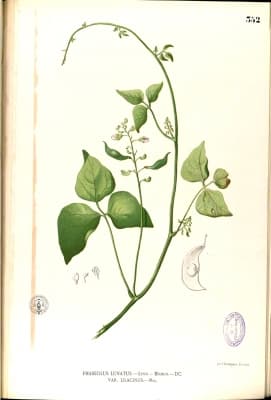
Phaseolus lunatus
Phaseolus lunatus
Safety & Hazards
The raw mature seed, especially of wild forms, is poisonous. The toxic principle is hydrocyanic acid and this is destroyed by thoroughly cooking the seed and discarding the water[ 200 Title The New RHS Dictionary of Gardening. 1992. Publication Author Huxley. A. Publisher MacMillan Press Year 1992 ISBN 0-333-47494-5 Description Excellent and very comprehensive, though it contains a number of silly mistakes. Readable yet also very detailed. ].
Botanical Description
Phaseolus lunatus is an annual to herbaceous perennial climbing plant producing twining stems generally up to 4 metres long, though sometimes as much as 8 metres long, from a fibrous rootstock that can be somewhat fleshy. The much-branched stems scramble over the ground or twine into the surrounding vegetation or any provided supports[ 299 Title Protabase - Plant Resources of Tropical Africa. Publication Author Website http://www.prota.org Publisher Year 0 ISBN Description An excellent on-line database with detailed information on over 3,200 species of useful plants of Africa. , 1555 Title Taxonomy, Distribution, and Ecology of the Genus Phaseolus (Leguminosae-Papilionoideae) in North America, Mexico and Publication SIda, Botanical Mlscellany, No 23 Author Freytag G.F. & Debouck D.G. Website http://www.brit.org/sida Publisher Botanical Researeh Institute of Texas Year 2002 ISBN 1-889878-11-1 Description An excellent, detailed study of the genus Phaseolus, it has been made available on-line as an open access document. ]. Lima bean is a very popular food crop, being used mainly for its seeds and immature seedpods. There are many different varieties of the plant, producing a wide range of beans, including the large, white 'butter bean'. The plant was already widely cultivated in the Americas before the arrival of the Europeans, who then spread it thoughout Africa, Asia etc. It is widely cultivated nowadays for its edible seed and seedpods in many tropical to warm temperate areas of the world[ 183 Title Cornucopia - A Source Book of Edible Plants. Publication Author Facciola. S. Publisher Kampong Publications Year 1990 ISBN 0-9628087-0-9 Description Excellent. Contains a very wide range of conventional and unconventional food plants (including tropical) and where they can be obtained (mainly N. American nurseries but also research institutes and a lot of other nurseries from around the world. , 200 Title The New RHS Dictionary of Gardening. 1992. Publication Author Huxley. A. Publisher MacMillan Press Year 1992 ISBN 0-333-47494-5 Description Excellent and very comprehensive, though it contains a number of silly mistakes. Readable yet also very detailed. ].