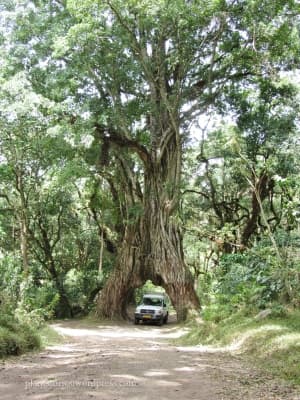
Ficus thonningii
Ficus thonningii
Safety & Hazards
None known
Botanical Description
Strangler fig is an evergreen tree with a rounded to spreading, dense crown; it can grow 6 - 21 metres tall[ 418 Title Ecocrop Publication Author Website http://ecocrop.fao.org/ecocrop/srv/en/home Publisher Year 0 ISBN Description Basic information on a wide range of useful plants, plus details of environmental needs where available. ]. The plant often begins life as an epiphyte, growing in the branch of another tree; as it grows older it sends down aerial roots which, when they reach the ground quickly form roots and become much thicker and more vigorous. They supply nutrients to the fig, allowing it to grow faster than the host tree. The aerial roots gradually encircle the host tree, preventing its main trunk from expanding, whilst at the same time the foliage smothers the foliage of the host. Eventually the host dies, leaving the fig to carry on growing without competition. It eventually becomes a stilt-rooted, banyan-like tree with multiple ascending trunks and massive wide-spreading branches[ 332 Title The Useful Plants of West Tropical Africa. Publication Author Burkil. H. M. Publisher Royal Botanic Gardens; Kew. Year 1985 - 2004 ISBN Description Brief descriptions and details of the uses of over 4,000 plants. A superb, if terse, resource, it is also available electronically on the Web - see http://www.aluka.org/ ]. The tree is harvested from the wild for its fruit, medicinal virtues and the various commodities it can supply. It is often planted to offer cover from the scorching sun in recreational areas, market centres and schoolyards. It can also be planted to provide shelter during the cold winter months[ 303 Title World Agroforesty Centre Publication Author Website http://www.worldagroforestry.org/ Publisher Year 0 ISBN Description An excellent online database of a huge range of trees giving very good information on each plant - its uses, ecology, identity, propagation, pests etc. ].