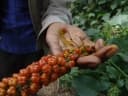
Phytolacca dodecandra
Phytolacca dodecandra
Safety & Hazards
Very poisonous[ 328 Title African Flowering Plants Database Publication Author Website http://www.ville-ge.ch/musinfo/bd/cjb/africa/recherche.php Publisher Conservatoire et Jardin Botaniques. Year 0 ISBN Description Contains information on over 150,000 plant names (including synonyms) giving a description and habitat, plus a distribution map. ]. Eating the fruits or leaves may cause acute poisoning, resulting in nausea, bloody diarrhoea, intense congestion of the stomach and intestines, vomiting, weakness, weak and irregular pulse, dilated pupils, swelling of the mucous membrane in the mouth and stupor; death may occur within a few days[ 299 Title Protabase - Plant Resources of Tropical Africa. Publication Author Website http://www.prota.org Publisher Year 0 ISBN Description An excellent on-line database with detailed information on over 3,200 species of useful plants of Africa. ]. Although the solutions of crushed fruits kill a range of aquatic life forms, including small fish, leeches, mosquito larvae, other stages of the bilharzia life-cycle (miracidia and cercariae), zebra mussels and tadpoles, the active ingredients are easily biodegradable and are eliminated from the water within 48 hours. Insect larvae and tadpoles are not affected at the concentrations that kill fish and snails[ 299 Title Protabase - Plant Resources of Tropical Africa. Publication Author Website http://www.prota.org Publisher Year 0 ISBN Description An excellent on-line database with detailed information on over 3,200 species of useful plants of Africa. ].
Botanical Description
Phytolacca dodecandra is usually a semi-succulent, straggling or scrambling evergreen shrub growing up to 4 metres tall[ 328 Title African Flowering Plants Database Publication Author Website http://www.ville-ge.ch/musinfo/bd/cjb/africa/recherche.php Publisher Conservatoire et Jardin Botaniques. Year 0 ISBN Description Contains information on over 150,000 plant names (including synonyms) giving a description and habitat, plus a distribution map. ]. Sometimes it becomes a climbing plant with stems up to 10, occasionally 20 metres long[ 299 Title Protabase - Plant Resources of Tropical Africa. Publication Author Website http://www.prota.org Publisher Year 0 ISBN Description An excellent on-line database with detailed information on over 3,200 species of useful plants of Africa. ]. The trunk is sometimes up to 35cm in diameter[ 299 Title Protabase - Plant Resources of Tropical Africa. Publication Author Website http://www.prota.org Publisher Year 0 ISBN Description An excellent on-line database with detailed information on over 3,200 species of useful plants of Africa. ]. Although toxic, this is a very popular medicinal plant in Africa, where it has a wide range of applications, many of which have been borne out by scientific research. The plant is also widely used as a source of saponins for washing and also to control disease-carrying molluscs. It is also sometimes used for food, even though there are many reports of toxicity. The plant is sometimes cultivated on a small scale in Africa, where the fruits are commonly sold as a soap substitute in local markets[ 299 Title Protabase - Plant Resources of Tropical Africa. Publication Author Website http://www.prota.org Publisher Year 0 ISBN Description An excellent on-line database with detailed information on over 3,200 species of useful plants of Africa. ].