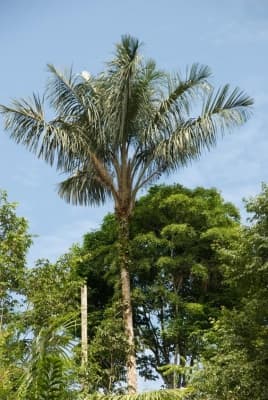
Astrocaryum chambira
Astrocaryum chambira
Safety & Hazards
None known
Botanical Description
Astrocaryum chambira is an evergreen, single-stemmed palm tree growing from 3.5 - 30 metres tall. The unbranched stem is covered in black spines that are up to 20cm long; it can be 19 - 35cm in diameter and is crowned by a rosette of 9 - 16 erect leaves that can each be 5 metres or more long[ 768 Title Field Guide to the Palms of the Americas Publication Author Henderson A.; Galeano G.; Bernal R. Publisher Princeton University Press; Princeton, New Jersey. Year 1995 ISBN 0-691-08537-4 Description An excellent book, giving basic information on all the 550 species of palms native to the Americas that were known in 1995. Comprehensive information on the plants range and habitat, brief description, some uses and almost 250 photos. ]. The tree is commonly harvested for local use, especially for its fibre, but also for its edible apical bud and medicinal uses. It is often planted because of its useful properties[ 768 Title Field Guide to the Palms of the Americas Publication Author Henderson A.; Galeano G.; Bernal R. Publisher Princeton University Press; Princeton, New Jersey. Year 1995 ISBN 0-691-08537-4 Description An excellent book, giving basic information on all the 550 species of palms native to the Americas that were known in 1995. Comprehensive information on the plants range and habitat, brief description, some uses and almost 250 photos. ]. This species has become a locally significant resource for the fibre extracted from its leaves - by-products (especially bags and hammocks) are marketed through the craft industry network at both regional and national level in Colombia, Ecuador, and Peru[ 1869 Title The genus Astrocaryum (Arecaceae) Publication Rev. peru. biol. 15(supl. 1): 031- 048 (Noviembre 2008) Author Kahn F. Publisher Year 2008 ISBN 1727-9933 Description ]. The fibre is used traditionally to make many items, especially hammocks. Mature trees are often cut down in order to gather the fibre, which kills the tree, and since a single large hammock may require as many as twenty trees, this tree is one of the resources that may become scarce if a village remains in one area for a long time[ 172 Title Discovering Wild Plants - Alaska, W. Canada and the Northwest. Publication Author Schofield. J. J. Publisher Alaska Northwest Books; Alaska Year 2003 ISBN 0882403699 Description A nice guide to some useful plants in that area. ]..