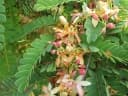
Tamarindus indica
Tamarindus indica
Safety & Hazards
None known
Botanical Description
Tamarindus indica is a long lived and beautiful fruiting tree, growing up to 30 metres tall with a dense, spreading crown. The tree has fragrant flowers and a feathery foliage that is usually evergreen but becomes deciduous in drier regions[ 200 Title The New RHS Dictionary of Gardening. 1992. Publication Author Huxley. A. Publisher MacMillan Press Year 1992 ISBN 0-333-47494-5 Description Excellent and very comprehensive, though it contains a number of silly mistakes. Readable yet also very detailed. , 774 Title Trees and Shrubs of the Sahel. Their Characteristics and Uses. Publication Author von Maydell H. Publisher Deutsche Gesellschaft fur Technische Zusammenarbeit; Germany Year 1990 ISBN 3-8236-1198-4 Description A well-researched book, usually with more than one photograph of each species and good information on the plant and its uses. ]. The bole is usually short, 1 - 2 metres in diameter[ 303 Title World Agroforesty Centre Publication Author Website http://www.worldagroforestry.org/ Publisher Year 0 ISBN Description An excellent online database of a huge range of trees giving very good information on each plant - its uses, ecology, identity, propagation, pests etc. ]. The seedpod of the tamarind is widely used for food in the tropics. The tree also yields a number of other edible uses, as well as having a wide range of medicinal applications and other uses. The tree is widely cultivated in the tropics and subtropics as an ornamental plant, for its edible seedpods and also for its many medicinal uses[ 200 Title The New RHS Dictionary of Gardening. 1992. Publication Author Huxley. A. Publisher MacMillan Press Year 1992 ISBN 0-333-47494-5 Description Excellent and very comprehensive, though it contains a number of silly mistakes. Readable yet also very detailed. ]. Tamarindus indica is a large tree with a wide geographical distribution. Although the origin of this species is not fully resolved, it is thought to originate in tropical Africa, but has been an ancient introduction to many countries. The population is large, and there are no known threats. The plant is classified as 'Least Concern' in the IUCN Red List of Threatened Species(2013)[ 338 Title IUCN Red List of Threatened Species Publication Author Website http://www.iucnredlist.org/ Publisher Year 0 ISBN Description A list of plants under threat and facing possible extinction, usually with brief details of the threats and information on habitat. ].