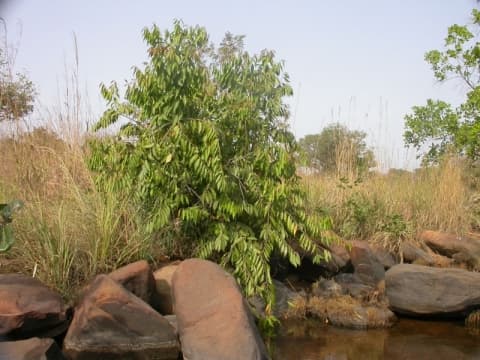
Anthostema senegalense
Anthostema senegalense
Safety & Hazards
Latex is present in the bark, young shoots, leaves, flowers and fruit. It is very toxic, acrid and vesicant. It is harmful to mucous membranes and it is known to all races as being very dangerous to the eyes and capable of causing blindness[ 332 Title The Useful Plants of West Tropical Africa. Publication Author Burkil. H. M. Publisher Royal Botanic Gardens; Kew. Year 1985 - 2004 ISBN Description Brief descriptions and details of the uses of over 4,000 plants. A superb, if terse, resource, it is also available electronically on the Web - see http://www.aluka.org/ ]. Leafy twigs and inflorescences are chopped up as a fish-poison[ 332 Title The Useful Plants of West Tropical Africa. Publication Author Burkil. H. M. Publisher Royal Botanic Gardens; Kew. Year 1985 - 2004 ISBN Description Brief descriptions and details of the uses of over 4,000 plants. A superb, if terse, resource, it is also available electronically on the Web - see http://www.aluka.org/ ], and in rice fields branches of the leafy twigs are placed at water intake sluices to kill fish that eat the young rice plants[ 332 Title The Useful Plants of West Tropical Africa. Publication Author Burkil. H. M. Publisher Royal Botanic Gardens; Kew. Year 1985 - 2004 ISBN Description Brief descriptions and details of the uses of over 4,000 plants. A superb, if terse, resource, it is also available electronically on the Web - see http://www.aluka.org/ ].
Botanical Description
Anthostema senegalense is usually a tree growing 20 - 30 metres tall, though in Senegal and The Gambia its stature is appreciably less, and the plant is often no more than a shrub, The straight bole can be 60cm in diameter[ 332 Title The Useful Plants of West Tropical Africa. Publication Author Burkil. H. M. Publisher Royal Botanic Gardens; Kew. Year 1985 - 2004 ISBN Description Brief descriptions and details of the uses of over 4,000 plants. A superb, if terse, resource, it is also available electronically on the Web - see http://www.aluka.org/ ]. Although very poisonous, the plant is often used for medicinal purposes within its native range, where it is commonly harvested from the wild. The tree also furnishes a timber,