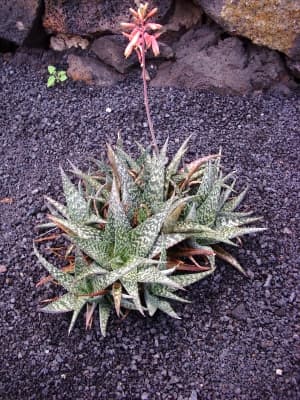
Aloe zebrina
Aloe zebrina
Safety & Hazards
The sap of Aloe species contains anthraquinones. These compounds have several beneficial medicinal actions, particularly as a laxative, and many species of Aloe are thus employed in traditional medicine. Whilst safe in small doses and for short periods of time, anthraquinones do have potential problems if used in excess. These include congestion and irritation of the pelvic organs[ 299 Title Protabase - Plant Resources of Tropical Africa. Publication Author Website http://www.prota.org Publisher Year 0 ISBN Description An excellent on-line database with detailed information on over 3,200 species of useful plants of Africa. ]. Long term use of anthraquinone laxatives may also play a role in development of colorectal cancer as they have genotoxic potential, and tumorigenic potential[ 299 Title Protabase - Plant Resources of Tropical Africa. Publication Author Website http://www.prota.org Publisher Year 0 ISBN Description An excellent on-line database with detailed information on over 3,200 species of useful plants of Africa. ].
Botanical Description
Aloe zebrina is a spiny, evergreen, succulent plant forming a compact rosette of spreading leaves; it grows 15 - 30cm tall. It is usually stemless, but can have a short stem. The plant often suckers freely to form large, dense groups[ 308 Title Flora Zambesiaca Publication Author Website http://apps.kew.org/efloras/fz/intro.html Publisher Year 0 ISBN Description An excellent online flora of plants from the Zambezi River basin. It lists a number of the plant uses as well as the habitats and botanical descriptions of the plants. , 663 Title Flora of Southern Africa Publication Author Roux J.P. Website http://plants.jstor.org/search?st=662545 Publisher Year 2003 ISBN Description An excellent on-line resource. ]. The plant is sometimes harvested from the wild for local use as a medicine and source of edible flowers and dyestuff. Like many other Aloe species, this plant has ornamental value and potential for cultivation in arid to semi-arid, frost-free locations[ 299 Title Protabase - Plant Resources of Tropical Africa. Publication Author Website http://www.prota.org Publisher Year 0 ISBN Description An excellent on-line database with detailed information on over 3,200 species of useful plants of Africa. ]. Some Aloe spp. Are extracted from wild sources for their various uses, but this is not thought to be a major threat to this species at present. Sustainable wild harvesting or cultivation protocols should be investigated. The plant is classified as 'Least Concern' in the IUCN Red List of Threatened Species(2013)[ 338 Title IUCN Red List of Threatened Species Publication Author Website http://www.iucnredlist.org/ Publisher Year 0 ISBN Description A list of plants under threat and facing possible extinction, usually with brief details of the threats and information on habitat. ].