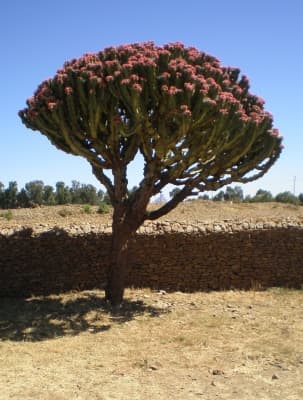
Euphorbia candelabrum
Euphorbia candelabrum
Safety & Hazards
The latex is very toxic and may cause blindness when it comes into contact with the eyes. It is also blistering and irritating to the skin and mucous membranes[ 299 Title Protabase - Plant Resources of Tropical Africa. Publication Author Website http://www.prota.org Publisher Year 0 ISBN Description An excellent on-line database with detailed information on over 3,200 species of useful plants of Africa. ]. The latex is an ingredient of arrow poison[ 299 Title Protabase - Plant Resources of Tropical Africa. Publication Author Website http://www.prota.org Publisher Year 0 ISBN Description An excellent on-line database with detailed information on over 3,200 species of useful plants of Africa. ]. Fresh, pounded branches are thrown into watering holes and streams as a fish poison and to poison wild animals[ 299 Title Protabase - Plant Resources of Tropical Africa. Publication Author Website http://www.prota.org Publisher Year 0 ISBN Description An excellent on-line database with detailed information on over 3,200 species of useful plants of Africa. ]. The flowers of Euphorbia candelabrum produce much nectar, but the honey causes a burning sensation in the mouth, which is intensified by drinking water[ 299 Title Protabase - Plant Resources of Tropical Africa. Publication Author Website http://www.prota.org Publisher Year 0 ISBN Description An excellent on-line database with detailed information on over 3,200 species of useful plants of Africa. ].
Botanical Description
Euphorbia candelabrum is a succulent tree with branches that are persistent from around 3 metres upwards, almost erect, rebranching to form a large, broadly rounded crown. The tree usually grows up to 12 metres tall, though specimens up to 20 metres have been recorded. The bole is up to 90cm in diameter. Leaves are only present in young plants, photosynthesis being carried out by the green, cactus-like stems. All parts of the plant exude an abundant latex if injured[ 299 Title Protabase - Plant Resources of Tropical Africa. Publication Author Website http://www.prota.org Publisher Year 0 ISBN Description An excellent on-line database with detailed information on over 3,200 species of useful plants of Africa. ]. The plant is harvested from the wild for local use as a medicine and source of wood. It is grown in live fences and is also used as an ornamental.