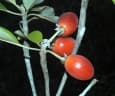
Manilkara kauki
Manilkara kauki
Safety & Hazards
None known
Botanical Description
Manilkara kauki is a medium-sized, evergreen tree with a dense, almost ovoid crown, that can grow up to 25 - 30 metres tall, though is more likely to be around 15 metres[ 303 Title World Agroforesty Centre Publication Author Website http://www.worldagroforestry.org/ Publisher Year 0 ISBN Description An excellent online database of a huge range of trees giving very good information on each plant - its uses, ecology, identity, propagation, pests etc. , 335 Title Perennial Edible Fruits of the Tropics : an Inventory Publication Author Martin, F. W.; Campbell, C. W.; Rubertbe, R. M. Publisher U.S. Dept. of Agriculture, Agricultural Research Service Year 1987 ISBN Description A booklet giving terse details of almost 300 species of edible fruits, plus regional lists of Botanical and Common names for over 2,500 less well-known edible fruits of the tropics. ]. It often has a gnarled and low-branched bole[ 303 Title World Agroforesty Centre Publication Author Website http://www.worldagroforestry.org/ Publisher Year 0 ISBN Description An excellent online database of a huge range of trees giving very good information on each plant - its uses, ecology, identity, propagation, pests etc. ]. Its edible fruit is gathered from the wild for local use, and the tree is sometimes planted in gardens and orchards[ 303 Title World Agroforesty Centre Publication Author Website http://www.worldagroforestry.org/ Publisher Year 0 ISBN Description An excellent online database of a huge range of trees giving very good information on each plant - its uses, ecology, identity, propagation, pests etc. ]. It is also grown as an ornamental fruiting tree, often planted near palaces and temples[ 303 Title World Agroforesty Centre Publication Author Website http://www.worldagroforestry.org/ Publisher Year 0 ISBN Description An excellent online database of a huge range of trees giving very good information on each plant - its uses, ecology, identity, propagation, pests etc. ].