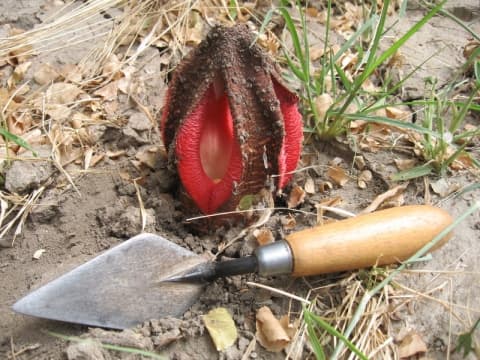
Hydnora abyssinica
Hydnora abyssinica
Safety & Hazards
None known
Botanical Description
Hydnora abyssinica is an unmistakable plant - a totally parasitic, perennial that is without any chlorophyll or leaves at all. With its vegetative parts looking more like a fungus, it is one of the strangest plants in the world. Its vegetative plant body is highly reduced and consists of only roots and flowers - it belongs to the only family of angiosperms with no leaves or scales of any sort. Parasitic on the roots of host trees, especially Acacia gerrardii and Lannea humilis, it has an underground stem, or pseudo-rhizome, that grows into the host's roots and so extracts food. The plant is only seen when the tips of the flowers push out of the ground - even the fruit develops below the soil surface[ 398 Title Edible Wild Plants of Tanzania Publication Author Ruffo, C.K.: Birnie, A. & Tengnas, B. Publisher Regional Land Management Unit; Nairobi. Year 2002 ISBN 9966-896-60-0 Description A very well presented, simple guide to growing and utilizing wild food plants in Tanzania, with line drawings of each plant, a description, habitat and range, non-food as well as food uses, plus basic information on growing the plants. , 590 Title The genus Hydnora Publication Author Website http://www.odu.edu/~lmusselm/plant/parasitic/hydnora_intro.php Publisher Old Dominion University Year 0 ISBN Description A downloaded web page giving fairly detailed information on the parasitic genus Hydnore. ]. The plant is harvested from the wild as a local source of food and medicine. The roots are sold in local markets for their medicinal uses[ 398 Title Edible Wild Plants of Tanzania Publication Author Ruffo, C.K.: Birnie, A. & Tengnas, B. Publisher Regional Land Management Unit; Nairobi. Year 2002 ISBN 9966-896-60-0 Description A very well presented, simple guide to growing and utilizing wild food plants in Tanzania, with line drawings of each plant, a description, habitat and range, non-food as well as food uses, plus basic information on growing the plants. ].