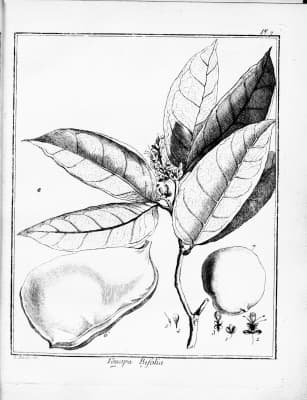
Macrolobium bifolium
Macrolobium bifolium
Safety & Hazards
None known
Botanical Description
Macrolobium bifolium is a deciduous tree with a large, dense, roundish crown; it can grow 5 - 18 metres tall[ 420 Title Brazilian Trees. Volume 2. 4th Edition. Publication Author Lorenzi. H. Publisher Instituto Plantarum De Estudos Da Flora; Brazil. Year 2002 ISBN 85-86714-15-1 Description Information on 350 species of Brazilian trees. Stunning photographs of each species, brief details on the plant, its uses and how to grow it from seed. A superb work, with the minor irritation that the translation from Portuguese is not of the best. , 1530 Title O gênero Macrolobium Schreb. (Leguminosae) no estado do Amapá, Brasil Publication Iheringia, Série Botânica, Porto Alegre, 72(2):267-275, 31 de agosto de 2017 Author Félix-da-Silva et al. Website http://10.21826/2446-8231201772213 Publisher Year 2017 ISBN 2446-8231 Description ]. The bole can be unbranched for more than half its height and up to 35cm in diameter[ 492 Title Timbers of British Guiana Publication Author Stone H.: Freeman W.G. Website http://www.biodiversitylibrary.org Publisher The Crown Agents for the Colonies: London. Year 1914 ISBN Description A guide to the woods of Guiana, though there is no description of the plants. It can be downloaded from the Internet. ]. The tree is harvested from the wild for local use as a medicine and source of wood. It is grown as a pioneer species for restoring degraded land, and is also planted as a shade tree along beaches of white sand[ 1529 Title Macrolobium Schreb. (Leguminosae, Caesalpinioideae) na Floresta Nacional de Caxiuanã, Pará, Brasil Publication Boletim do Museu Paraense Emílio Goeldi. Ciências Naturais 8(1): 75-93. 2012 Author Félix-Da-Silva, M.M., M.N.C. Bastos & E.S.C. Gurgel Publisher Year 2012 ISBN Description ]..